Yesterday, the broader financial sector enjoyed a solid rally. Money was flowing, sentiment was up, and traditional banking and asset management stocks were glowing green. But if you looked closely at the tape, there was a glaring, bloody anomaly: the absolute kings of traditional derivatives, CME Group and Cboe Global Markets, were tanking.
Cboe plummeted nearly 10%, while CME plunged as much as 4% intraday, hitting its lowest point in over a year. Intercontinental Exchange (ICE) dipped intraday before recovering, but the message was clear — the market was repricing the entire exchange sector.
Was it a bad earnings report? A sudden drop in trading volume? No.
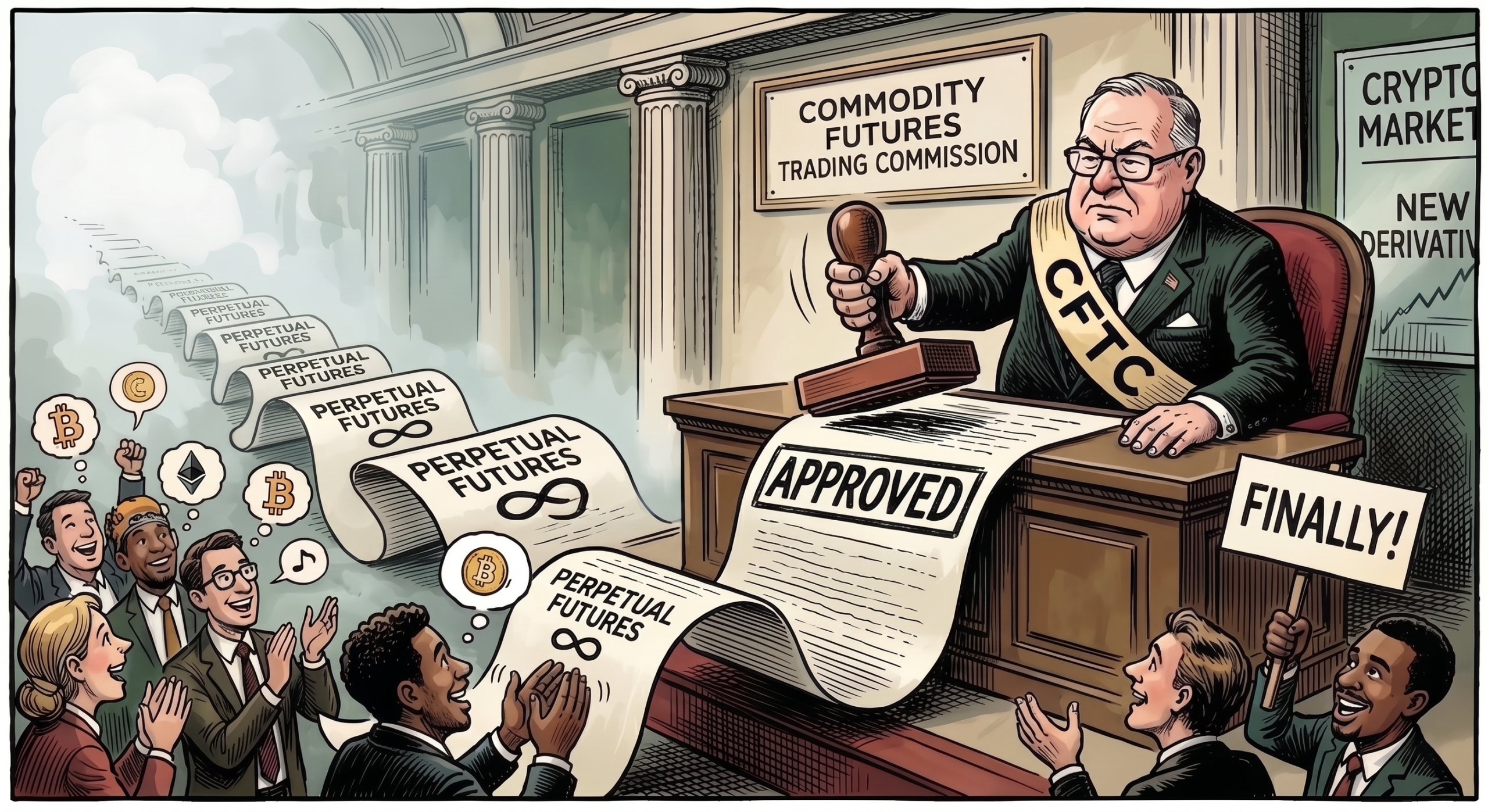
The immediate catalyst for this sudden institutional panic was an explosive live interview on CNBC’s Squawk Box on June 15, 2026. CFTC Chairman Michael Selig went on national television and fiercely, unapologetically defended the agency’s landmark May 29 decision to bring the most traded, highly weaponized instrument in crypto history onshore: The Perpetual Futures Contract.
Until that television appearance, traditional financial giants were still locked in a state of comfortable denial. They assumed that fierce lobbying from traditional finance or political friction would stall the rollout. But when Selig looked straight into the camera and bluntly declared that “incumbents will always fear the future,” arguing that the U.S. must capture this $93 trillion market domestically rather than exporting it offshore, Wall Street’s illusion shattered.
The market instantly realized this wasn’t a temporary regulatory quirk or a minor pilot program; it was a permanent, aggressive structural pivot backed by the highest levels of the current administration. The gunpowder was laid on May 29, but Selig’s live media defense was the match that lit the fuse—sending Cboe cascading nearly 10% and CME plunging as much as 4% in a single, brutal trading session.
To understand why traditional exchange operators are suddenly bleeding, you have to look past the crypto headlines and grasp the mechanics of what just happened. The market isn’t just pricing in a new competitor; it’s pricing in the potential obsolescence of a century-old business model.
The Instrument That Ate The Market
For the uninitiated, a perpetual futures contract (or “perp”) is exactly what it sounds like. It trades like a traditional futures contract, but it never expires.
In traditional finance, futures are anchored by time. A June contract expires in June. If you want to hold your position into July, you have to close your June contract and buy the July one—a process called “rolling over.” This creates friction, fragmented liquidity across different months, and most importantly, massive rollover fees for the exchanges.
Perps, invented by BitMEX in 2016, killed this friction. Instead of an expiration date, they use a “funding rate“—a periodic fee exchanged directly between long and short traders to keep the contract price tethered to the spot price. You open a position, and it stays open forever, or until you get liquidated.
It is the purest, most capital-efficient form of leverage ever created. And the numbers prove it. In 2025, the global perpetual market handled a staggering $92.9 trillion in trading volume—almost entirely operating on offshore platforms like Binance and Bybit, or decentralized behemoths like Hyperliquid (whose native HYPE token just blew past $76 on the back of $10 billion in open interest).
For years, US regulators kept this $93 trillion beast locked out of the country. If American institutions wanted leverage, they had to use CME’s clunky, expiry-based futures. It was a captive market.
Until May 29.
The Threat of Format Cannibalization
When Michael S. Selig took the helm as CFTC Chairman in late 2025 — one of the youngest to ever hold the post — he made his mandate clear: stop regulating by enforcement and bring offshore liquidity onshore.
The May 29 decision didn’t just approve Kalshi’s BTCPERP contract. It laid the groundwork for a massive structural shift. The CFTC essentially signaled that the “perpetual” format is no longer forbidden magic.
Here is where the true insight lies, and the exact reason why CME and Cboe shareholders are hitting the panic button.
The traditional exchanges aren’t terrified of losing their Bitcoin futures volume. Crypto derivatives make up only a fraction of CME’s total revenue. What they are terrified of is Format Cannibalization.
The CFTC’s policy statement explicitly left the door open for perpetual contracts referencing asset classes beyond crypto—including equities, commodities, and precious metals. Wall Street analysts immediately caught onto this. What happens if Kalshi, Coinbase, or Kraken starts offering 24/7, high-leverage, zero-expiration perpetual futures on the S&P 500? Or Crude Oil? Or Gold?
This isn’t just theory—it’s already playing out in the decentralized space. Hyperliquid recently launched perpetual futures on SpaceX pre-IPO contracts, doing over $1 billion in daily volume. They are proving that the perpetual format works beautifully for traditional and exotic assets, not just digital ones.
If retail and institutional traders realize they can trade Apple stock or WTI Crude 24/7 without ever paying a rollover fee or dealing with contract maturities, why would they ever go back to CME or Cboe?
The Battle for the Standard
CME Group’s CEO Terry Duffy recently called the CFTC’s perpetual approval “a disaster waiting to happen,” citing the systemic risks of high leverage and automatic liquidations. It’s a valid regulatory concern, but let’s read between the lines: it is the defensive cry of an incumbent watching a superior technology bypass its moat.
Right now, we are watching a three-way war unfold:
- The Incumbents (CME/Cboe): Defending the old-world expiry models, though CME recently capitulated by offering 24/7 trading for its crypto futures.
- The Middle Ground: Cboe trying to push “10-year expiry” continuous futures as a compliant compromise.
- The Insurgents (Kalshi, Coinbase, Kraken/Bitnomial, Hyperliquid): Armed with true perps, crypto-native collateral, and zero legacy baggage.
What Comes Next?
We’ve seen this movie before. In December 2017, CME listed Bitcoin futures, giving Wall Street a way to short the market and triggering a brutal bear winter. In January 2024, the SEC approved spot ETFs, unleashing a torrent of institutional capital that drove Bitcoin to new all-time highs.
The May 2026 Perp Approval is the third major inflection point, but its implications go far beyond crypto.
The $93 trillion offshore market wasn’t built because people inherently love offshore platforms. It was built because the US plumbing was outdated, and regulators refused to upgrade it. Now, the plumbing is finally being replaced.
The blood on the streets for traditional exchanges yesterday was a realization that the “Perpetual Revolution” isn’t just about Bitcoin. It’s about the underlying architecture of how the world trades risk. And right now, the old guard is standing on the wrong side of financial history.
Sources & Primary Documents
CFTC Official Releases — May 29, 2026
- Order Approving KalshiEX BTCPERP Contract (PR 9240-26)
- Policy Statement on Listing of Perpetual Contracts (PR 9242-26)
- No-Action Letter on Coinbase/Deribit Foreign Futures (PR 9241-26)
- Staff Advisory on 24/7 Trading, Clearing, and Settlement (PR 9239-26)
Market Data
- CoinGlass — 2025 Crypto Derivatives Market Annual Report
- CoinGecko — The Meteoric Rise of Perp DEXs (2026)
- Kalshi — First-Ever Perpetual Futures in America (May 29, 2026)
Analysis
Leave a Reply