Wall Street returned from the Independence Day weekend with its risk appetite fully restored.
The Dow Jones Industrial Average climbed 155.84 points to close at 53,055.91 — its first-ever finish above 53,000 and a fresh record, coming just days after Alphabet joined the 30-stock index. The Nasdaq Composite jumped 1.12% to 26,121.16 as semiconductor stocks staged a forceful rebound from their two-day rout, and the S&P 500 gained 0.72% to 7,537.43, pulling within 1% of its own record. The Russell 2000 reclaimed the 3,000 level.
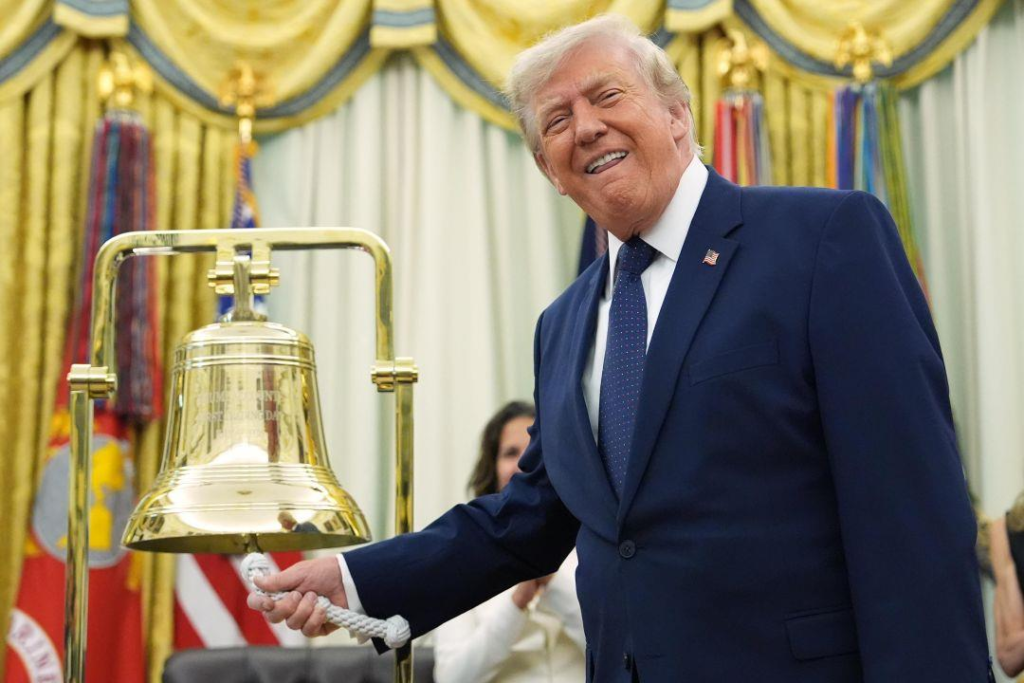
President Trump marked the occasion by ringing the opening bell at both the NYSE and Nasdaq remotely from the Oval Office — a fitting piece of theater for a market that has now set records across three consecutive weeks.
Yet beneath the celebratory tone, the session carried a familiar asterisk: the majority of stocks within the S&P 500 actually declined. The index-level gains were once again powered by a narrow band of AI-linked megacaps — a reminder that the rally’s breadth problem didn’t disappear over the holiday; it just got outshouted.
Index Performance
Rates, Dollar, Commodities
Chips Rebound: Foxconn’s Demand Signal and Morgan Stanley’s Upgrades
After shedding more than 11% from its late-June peak across two brutal sessions, the semiconductor complex found its footing. The VanEck Semiconductor ETF (SMH) opened up 2.7% and held its gains through the close, with Western Digital surging 7%, Teradyne adding 2.8%, and Oracle gaining 2.5%.
Two catalysts drove the reversal. Over the weekend, Nvidia supplier Hon Hai (Foxconn) reported stronger-than-expected quarterly sales — a concrete, real-economy data point suggesting AI hardware demand remains intact despite the market’s valuation anxieties. And on Monday morning, Morgan Stanley raised price targets across the chip equipment complex, lifting Lam Research more than 4% and pushing Applied Materials and KLA each up nearly 4%.
The bounce doesn’t settle the capex debate that hammered the sector last week — Meta’s cloud pivot and Zuckerberg’s candid townhall remarks are still fresh — but it does suggest the sell-off was driven more by positioning than by any deterioration in the underlying demand picture. The real tests arrive Tuesday, when Samsung Electronics reports preliminary Q2 earnings and SpaceX officially joins the Nasdaq 100.
Anthropic’s $19 Billion Lease Turns a Bitcoin Miner Into an AI Landlord
The day’s most striking deal came from an unlikely corner of the market. TeraWulf (WULF) — a former Bitcoin miner that has spent the past two years reinventing itself as an AI infrastructure developer — announced a 20-year lease agreement with Anthropic at its Justified Data campus in Hawesville, Kentucky. The lease is expected to generate approximately $19 billion in contracted revenue over its initial term — a figure that exceeds TeraWulf’s entire $12 billion market capitalization.
The campus, built on the site of a former aluminum smelting facility about an hour southwest of Louisville, will deliver roughly 401 megawatts of critical IT load, with initial capacity coming online in the second half of 2027 and full ramp by early 2028. The 790-acre site’s existing power transmission and fiber infrastructure — legacies of its industrial past — allow TeraWulf to skip years of permitting and construction that greenfield projects require.
Separately, TeraWulf announced the sale of its 50.1% stake in the Abernathy Joint Venture in Texas to an investor group led by partner Fluidstack for approximately $530 million — monetizing a $450 million investment at a premium and freeing capital for wholly owned projects.
Shares jumped as much as 19% before settling up 4.9% at $22.21 on volume 135% above average. The rally spilled across the entire miner-turned-AI-host cohort: Cipher Mining gained 8.4% and IREN surged 13.1%. The trade is now unmistakable — former crypto miners with secured power capacity have become some of the most valuable real estate in the AI economy. For Anthropic, the deal extends an infrastructure buildout that already includes the $1.25 billion-per-month Colossus lease with SpaceX and more than a dozen letters of intent with data center developers.
Around the Market
Broadcom announced it will extend its chip partnership with Apple through 2031, signing new multi-year agreements covering custom ASIC silicon for multiple future Apple product generations. The deal relieves a persistent investor concern — that Apple’s in-house silicon push would gradually squeeze out key suppliers. With Apple representing roughly 20% of Broadcom’s business, the extension locks in revenue visibility for years, and both stocks edged higher on the news. The agreement also reads as a broader signal: in a semiconductor market scrambled by the AI memory shortage, companies are paying a premium for supply chain stability.
Microsoft slipped nearly 1% after announcing it will cut 4,800 jobs — about 2.1% of its workforce — with most of the reductions concentrated in the Xbox gaming unit and the remainder in commercial sales. The layoffs continue Big Tech’s pattern of trimming legacy businesses to fund AI infrastructure spending, echoing Meta’s restructuring earlier this year.
Amazon rose 0.8% after reports that the company is raising $25 billion in a bond sale — the latest hyperscaler to tap debt markets to fund AI infrastructure, following a pattern that has seen Big Tech’s combined borrowing accelerate sharply this year.
Comcast added 0.5% after its UK subsidiary Sky announced the acquisition of ITV’s television business, a consolidation move that comes as Comcast prepares to spin off its media assets into a standalone company.
Oil slipped, with Brent near $72 and WTI around $68.60, pressured by an OPEC+ output hike announced over the weekend. The pullback in crude gave airlines and consumer discretionary names an added tailwind.
Oppenheimer’s chief investment strategist John Stoltzfus captured the prevailing mood in a Monday note, arguing that “so long as the stateside fundamentals that benefited investors in the first half remain intact or improve, there’s upside to equities ahead” — while flagging information technology, communication services, industrials, financials, and consumer discretionary as the sectors to watch.
Bottom Line
Monday’s session restored the AI trade’s momentum without resolving its contradictions. The same market that spent last week punishing semiconductor stocks for capex excess spent Monday rewarding a $19 billion, 20-year infrastructure commitment — because the check was signed by an AI lab rather than a hyperscaler. The distinction matters: Anthropic leasing purpose-built capacity is demand made tangible, while Meta renting out excess GPUs is supply looking for a buyer.
The Dow above 53,000, the S&P within 1% of its record, and chip stocks bouncing on real demand signals from Foxconn — the setup into Tuesday is constructive. But with most S&P 500 constituents declining on an up day, the market’s fate remains concentrated in remarkably few hands. Samsung’s earnings and SpaceX’s index debut will tell us whether this week extends the rebound or reopens the debate.
Leave a Reply