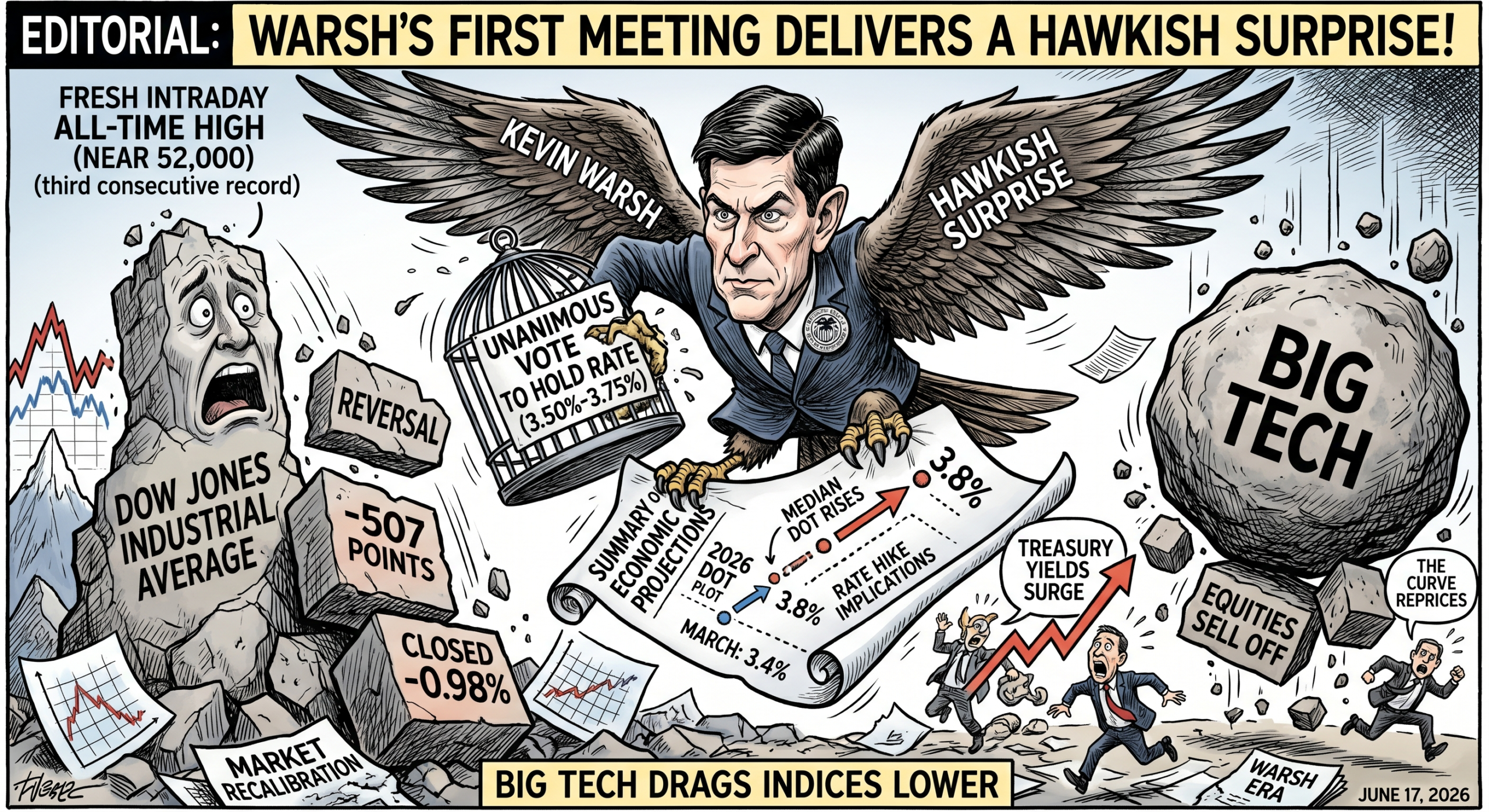
Warsh’s first FOMC as Federal Reserve Chair captured a sharp reversal driven entirely by a single event. The Dow Jones Industrial Average had touched a fresh intraday all-time high near 52,000 — its third consecutive record — before the post-2 PM ET communication triggered a broad-based reversal across asset classes. By the close, the index had given back 507 points, finishing -0.98%.
The Federal Open Market Committee voted unanimously (12-0) to hold the federal funds rate at 3.50%–3.75%, as widely expected. But the updated Summary of Economic Projections delivered a decisive hawkish surprise: the median year-end 2026 dot moved from 3.4% in March to 3.8%, implying at least one rate hike before December. Treasury yields surged, equities sold off, and the curve repriced the Warsh era within minutes.
Index Performance
Mega-cap technology led the decline. Microsoft, Meta Platforms, Alphabet, and Amazon all closed in the red, dragging the S&P 500 and Nasdaq lower in tandem. The Russell 2000, which had traded up nearly +1.2% intraday on hopes of a small-cap-friendly Fed posture, gave back nearly all its gains by the close. Breadth deteriorated meaningfully into the final hour — 56.4% of issues declined against 40.5% advancing.
Rates, Dollar, Commodities
The bond market delivered the most violent reaction. The 2-year Treasury yield jumped more than 16 basis points to 4.216%, the largest single-session move under a new Fed chair since the 1990s. The 10-year yield climbed roughly 6.9 bps to 4.497%. The CBOE Volatility Index (VIX) surged 12%, reflecting a sudden repricing of policy uncertainty.
Crude oil pared earlier weakness after President Trump signaled, from the G7 summit in Évian-les-Bains, that the Iran ceasefire remained a memorandum of understanding rather than a final deal — warning the US would “go right back to dropping bombs” if Tehran failed to comply. WTI and Brent both ticked higher into the close. Gold held its ground as a hedge against the policy ambiguity Warsh deliberately introduced.
The Warsh Doctrine: Less Communication, More Discretion
Three communication signals from Warsh’s first FOMC deserve to be parsed carefully, because they together define the institutional posture of the Warsh-era Fed:
- Abstention from the Dot Plot. Warsh confirmed at the press conference that he submitted no individual rate forecast. “I did not submit a dot for me,” he said. “It’s not helpful in the conduct of policy.” This means the median 3.8% projection reflects only 18 of 19 participants — a structural ambiguity that complicates clean interpretation of the SEP.
- A Dramatically Shorter Statement. The post-meeting communique came in at just 130 words, against 341 words for the April release. Warsh removed the easing bias language entirely and stripped the document down to what he described as “the facts, as best we can judge it.” Forward guidance, in any meaningful sense, has been dropped.
- Five Task Forces. Warsh announced the formation of five internal review groups covering monetary policy operations, communications, data sources, productivity, and the labor market. The most consequential of these will examine the Fed’s $6.7 trillion balance sheet — a long-running Warsh critique now becoming formal agency policy. He framed the question directly: whether monetary policy “originates from our rate tools, or from our balance sheet tools.”
When asked about the 2% inflation target, Warsh dismissed any reconsideration outright: “I see no reason until we have reestablished our commitment and ability to deliver on the 2% inflation objective to revisit that.” With headline CPI running at 4.2% y/y in May — the highest since April 2023 — that commitment implies a meaningful runway of restrictive policy.
The Dot Plot Split: Nine vs Nine
The composition of the new dot plot tells a story of a deeply divided committee:
- 9 of 18 participants project at least one rate hike before year-end.
- 6 of those 9 see two or more 25-basis-point hikes as plausible.
- The remaining 9 project either a hold or a cut.
Despite the even split, the median moved up because the hawkish dots clustered tighter and higher. PCE inflation projections were also revised meaningfully — from 2.7% in March to 3.6% at year-end 2026 — while real GDP forecasts were cut from 2.4% to 2.2%. The committee now sees slower growth alongside stickier inflation, the textbook setup for restrictive policy persistence.
Following Warsh’s repeated emphasis on “price stability” during the press conference, money markets repriced October as the operative hike window. The CME FedWatch tool moved to 60.7% odds of a rate hike at the October meeting — up from below 50% before the announcement.
Mega-Cap Tech: Duration Risk Reasserts Itself
The mechanism connecting Warsh’s communication framework to mega-cap technology is not abstract. Every equity is the present value of expected future cash flows, discounted back to today. When the risk-free rate moves meaningfully higher — and when forward guidance is removed, the risk premium widens with it — the longest-duration cash flows take the largest mark-down. AI infrastructure names, with the most back-loaded earnings profiles in the index, are the first to feel it.
Microsoft, Meta, Alphabet, and Amazon all closed lower. SpaceX (SPCX) declined 4.9%, breaking the consecutive-day winning streak that had carried it past Amazon’s market cap on Tuesday. The selloff in SPCX appeared to be a clean duration unwind rather than a fundamental reassessment — institutional desks trimming the most extended positions first.
Semiconductors: A Quiet Counterpoint
Beneath the broad index decline, the semiconductor complex staged a notable rebound from Tuesday’s gamma-driven drawdown. The Philadelphia Semiconductor Index (SOX) closed +1.4%, partially offsetting the broader market weakness.
Three names drove the recovery:
- Broadcom (AVGO) advanced on continued strength in AI accelerator bookings.
- Micron (MU) rebounded after Tuesday’s -6.18% selloff, with HBM scarcity continuing to support the multi-quarter thesis.
- Applied Materials (AMAT) gained following Citi’s price-target hike from $550 to $710, citing fab capacity expansion.
The semiconductor recovery against a tape this weak suggests Tuesday’s drawdown was indeed mechanical positioning rather than fundamental deterioration — a pattern the AI hardware complex has now seen multiple times this year.
Bottom Line
Wednesday’s tape was, fundamentally, a single-handed repricing. Warsh’s first FOMC introduced not just a new median dot but a new communication framework.
Warsh has, in effect, reset the institutional rules of engagement. By withdrawing his own dot, compressing the statement, dropping the easing bias, and announcing five structural review task forces, he signaled that the Fed will provide markets with less forward visibility, not more. For the rates market, that means a higher risk premium. For long-duration equities, that means a lower multiple. For the broader macroeconomic outlook, it means policy decisions will be made in real time and communicated parsimoniously.
The Dow’s near-record reversal, the 16-basis-point 2-year jolt, and the 12% VIX spike all reflect the market doing in one afternoon what Warsh’s predecessors had spent months pre-signaling. Whether that approach proves stabilizing or destabilizing over a full cycle is the central question of the new chairmanship.
The October meeting is now the market’s focal point.
Leave a Reply