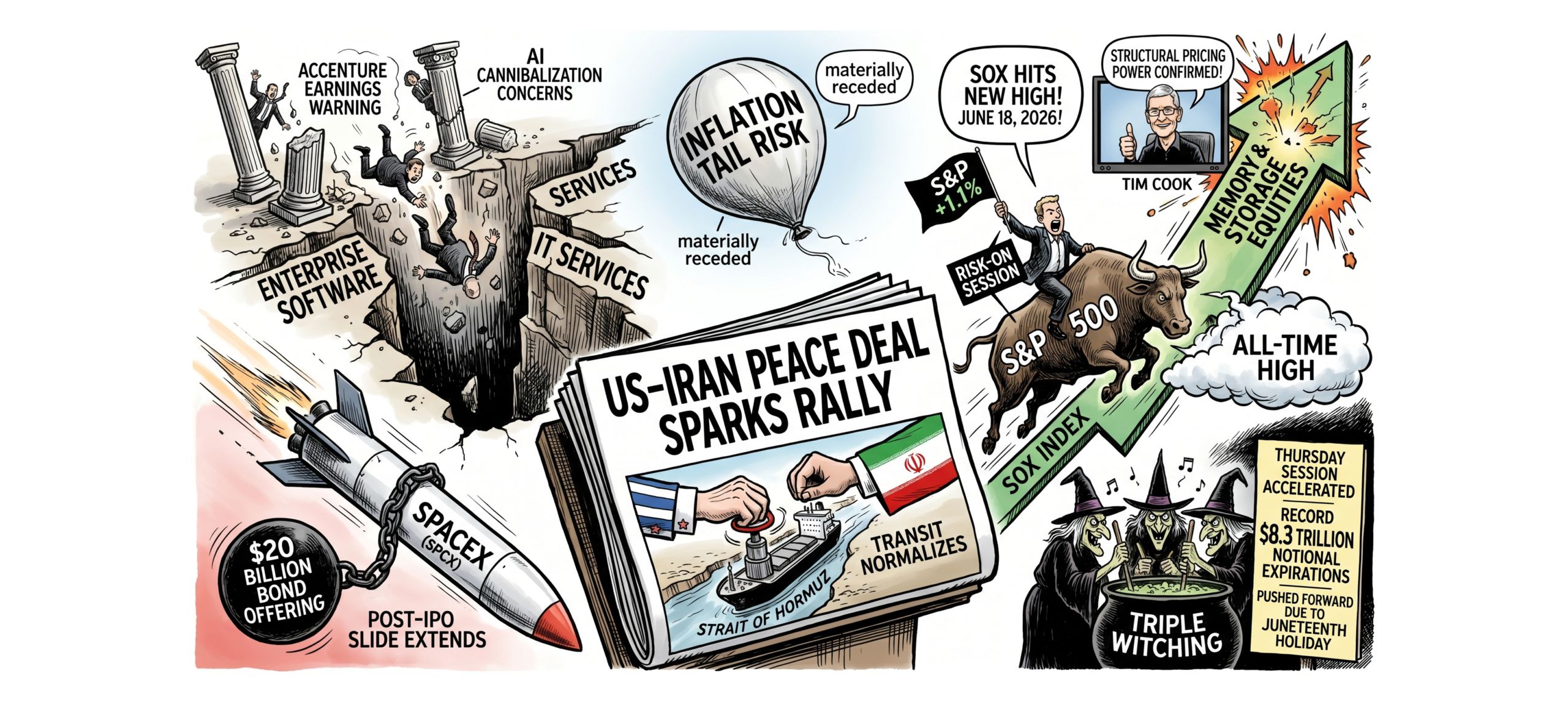
The SOX all time high on June 18, 2026 capped a risk-on session driven by the formal entry-into-force of the US–Iran ceasefire MOU. With transit through the Strait of Hormuz beginning to normalize, the inflation tail risk that had defined much of the second quarter receded materially. The S&P 500 closed +1.1% and equity markets responded with broad-based buying — though beneath the headline rally, the tape told a highly bifurcated story.
Memory and storage equities staged the day’s most explosive moves following a Tim Cook interview that effectively confirmed structural pricing power. Enterprise software, conversely, collapsed on an Accenture earnings warning, reigniting concerns about AI cannibalizing IT services demand. Meanwhile, SpaceX (SPCX) extended its post-IPO slide, weighed down by an impending $20 billion bond offering.
Thursday’s session also marked an accelerated “triple witching”—the quarterly expiration of stock options, index options, and futures—pushed forward due to Friday’s Juneteenth holiday, with notional expirations estimated at a record $8.3 trillion.
Index Performance
The major averages reflected a broadly constructive, albeit tech-heavy, tape. The S&P 500 closed higher by +1.1%, finding support as geopolitical risk premiums unwound. The Nasdaq Composite rode the coattails of a massive semiconductor melt-up, completely shaking off the gamma-driven drawdown seen earlier in the week. The Dow Jones Industrial Average participated in the rally, though its gains were more muted compared to the tech-heavy benchmarks, reflecting a session where capital flows distinctly favored silicon over traditional industrials.
Overall market breadth was positive, signaling that the mechanical positioning adjustments from earlier in the week have cleared, allowing fundamental drivers to dictate price action.
Rates, Dollar, Commodities
The macro showed a violent unwinding of the geopolitical risk premium, characterized by softening yields, a sharp flush in precious metals, and stabilizing energy costs:
- Treasury Yields: The curve shifted lower as flight-to-safety bids dissolved. The 10Y Yield fell to 4.451% (-0.036, -0.80%), while the 30Y Yield led the long-end recovery, sliding to 4.901% (-0.074, -1.49%).
- US Dollar: The Dollar Index (DXY) bucked the broader risk-on trend, catching a mechanical or positioning-driven bounce to close up at 100.850 (+0.760, +0.76%).
- Commodities: Gold suffered an absolute drubbing, plunging -3.09% (-$134.80) to close at $4,224.10. In energy, WTI Crude edged down slightly to $76.60 (-0.19, -0.25%), while Natural Gas posted a solid gain of +2.80% to close at $3.23 (+0.09).
The SOX All Time High: Intel-Led Breakout
The cleanest signal in Thursday’s tape came directly from the semiconductor complex, where the SOX all time high confirmed that the early-week volatility was mechanical rather than a breakdown in the core thesis.
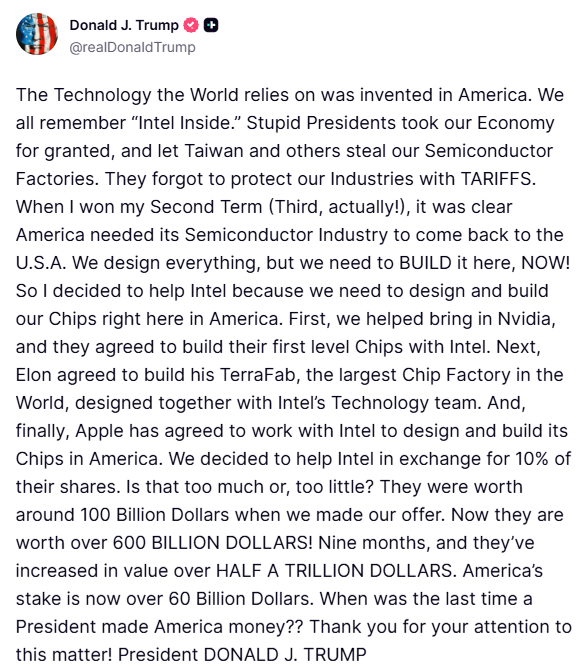
The index’s breakout was heavily anchored by Intel (INTC). President Trump’s social media post indicating that Intel would collaborate with Apple to design and manufacture chips domestically triggered immediate buying. This builds directly on the Apple-Intel preliminary foundry agreement announced in early May, cementing the administration’s narrative of domestic chip production anchored by the US government’s September 2025 equity stake in Intel.
Reverberations extended cleanly down the supply chain into semiconductor equipment. KLA Corp, Applied Materials, and Lam Research all advanced as the market priced in the massive capital expenditure cycle required for expanded US foundry capacity. These equipment names sit at the most leveraged point of the onshoring narrative: every new fab requires their tools, and every Intel customer win expands their total addressable wafer demand.
The Memory Trade: Cook’s Confirmation
The most consequential single-day move belonged to the memory and storage complex, which contributed materially to the SOX all time high. In a Wall Street Journal interview, Apple CEO Tim Cook explicitly acknowledged that memory and storage chip costs have reached a level Apple can no longer absorb. Stating that “price increases are unavoidable” and the supply situation has “become unsustainable,” Cook compared the current shortage to a “hundred-year flood.”
When the world’s largest consumer-electronics buyer publicly concedes pricing power to its suppliers, the market read-through is immediate and mechanical. Apple sources NAND flash from Western Digital, SanDisk, and Micron, and DRAM from Micron, Samsung, and SK Hynix.
The session’s standout movers:
- SanDisk (SNDK): +11%, printing a fresh all-time intraday high near $2,176. The company’s most recent quarter posted revenue of $5.95B (+251% y/y) with gross margins at 78.4%. All 2026 capacity is sold out, and 2027 bookings are already categorized as strong.
- Western Digital (WDC): +7.7%, marking its sixth consecutive green session and putting it up +37% week-to-date.
- Micron (MU): +8.1% to $1,127, closing just below its 52-week high. Sell-side price targets have broadly moved above $1,000 ahead of next Wednesday’s earnings release.
The setup perfectly mirrors Bernstein’s earlier note: NAND pricing momentum and earnings trajectories have decoupled from broader semiconductor positioning. The structural shortage thesis is now being validated in real-time by end customers.
Software and IT Services: The Other Side of the Tape
Against the semiconductor melt-up, the enterprise software and IT services complex suffered a brutal sell-off. The proximate cause was Accenture’s (ACN) earnings release, which narrowed full-year fiscal 2026 revenue guidance and noted a $400 million Middle East-related impact in Q3, with further drag expected in Q4. The stock closed down -17.97%—its largest single-session decline in years.
Because Accenture serves as the primary bellwether for enterprise technology spending, the damage spread rapidly:
- IBM: -6.9% to $244.20
- Cognizant (CTSH): Dropped more than 8%, hitting a fresh 52-week low.
- Salesforce, Workday, Datadog, Snowflake, SAP: All closed firmly in the red.
The deeper market concern extends beyond a single quarter at Accenture. It is the resurfacing fear that generative AI is quietly eroding demand for human-delivered IT consulting and services. If AI agents can structure transformations, write code, and configure enterprise systems, the billable hours that anchor these revenue models compress. The price action across the cohort suggests allocators are actively repricing this risk.
This semiconductor-software divergence is the cleanest visualization of the current AI capital cycle: spending continues to aggressively flow toward the infrastructure layer (memory, equipment, foundries, accelerators) and away from the application and services layer.
SpaceX (SPCX): Two Sessions, $620 Billion Wiped
SpaceX extended its post-IPO drawdown into a second consecutive session, closing down approximately -3.76% at $184.97. Combined with Wednesday’s nearly 5% decline, the two-session move erased roughly $620 billion in market capitalization. However, the stock still trades more than 30% above its $135 IPO price from June 12.
Two distinct catalysts converged to drive the selling:
- The $20 Billion Bond Offering: Bloomberg reported that SpaceX is preparing investor calls for an investment-grade dollar bond issuance of at least $20 billion, led by a syndicate of major banks. Proceeds will refinance the bridge loan taken to fund the February xAI acquisition. With all three major rating agencies issuing investment-grade ratings, the deal is fully clearable. Initial panic over perceived dilution—following the $75 billion IPO raise and Tuesday’s $60 billion Anysphere acquisition—subsided slightly once the market digested that the issuance is purely a refinancing effort, allowing SPCX to trim intraday losses.
- Options-Linked Selling Pressure: Following Tuesday’s options launch, which concentrated massive open interest in single-name contracts, Thursday’s triple witching created a mechanical overhang.
The looming fundamental question for SPCX is the late-July lock-up expiration. With roughly 95% of shares locked at IPO and only a 4–5% public float, the first window for insider selling opens around the Q2 earnings release on August 6. Until that calendar clears, technicals will likely dominate the tape.
Macro Deep Dive: The Crude Rebalancing & Gold Liquidation
While equity indices celebrated the de-escalation, the commodities patch underwent a violent structural repricing as geopolitical risk premiums were violently stripped from the tape.
The Safe-Haven Flush in Gold
Gold suffered an absolute liquidation, plunging -3.68% to trade at $4,236.00 by the US equity close (16:00 ET). Measuring from the previous day’s official settlement, the drop wiped out more than $160 in a single session. While not matching the extreme volatility seen earlier this year, the violent price action represented a mechanical flush of the wartime premium. As the entry-into-force of the US-Iran ceasefire MOU signaled a structural drop in systemic risk, macro allocators aggressively rotated out of defensive hedges. This liquidation was heavily amplified by the broader macro backdrop: following Fed Chair Warsh’s hawkish inaugural FOMC on Wednesday, expectations of “higher for longer” rates mechanically drove up the opportunity cost of holding non-yielding assets, accelerating the rush back into risk and yield.
Crude Transits and the Wall Street Divide
WTI crude found a temporary floor, closing the US equity session with a modest -0.38% decline at $75.81 as physical bottlenecks began clearing. The lifting of US military blockade restrictions allowed an estimated 12.5 million barrels of oil to begin localized transit through the Strait of Hormuz. Vice President JD Vance directly managed potential friction points by dismissing market concerns regarding potential Iranian transit tolls, bringing immediate structural relief to supply-chain modeling.
However, the longer-term trajectory for crude has split the street into two aggressive camps:
The “Lower for Longer” Camp:
- Citi: Focuses on a return to pre-war dynamics, projecting Brent down to $60–$65 per barrel by Q1 2027 on structural oversupply and demand softness.
- Three structural supply-side headwinds: the lifting of sanctions on Iranian exports, OPEC+’s rolling production increases since late February, and the UAE’s exit from OPEC, which removes critical quota constraints.
- Kuwait Petroleum Corporation: The CEO confirmed that the country will scale production back above 2 million barrels per day within a week, recovering rapidly from a wartime low of 500,000 bpd.
The “Floor Holds” Camp:
- BNP Paribas: Argues that unwinding supply-side disruptions takes physical time, and a massive global strategic inventory rebuild cycle will keep Brent firmly anchored above $75 through year-end.
- ING: Suggests that even if localized energy inflation cools, the Federal Reserve will remain highly cautious regarding rate cuts, keeping the broader “Warsh hawkish framework” entirely intact.
Looking Ahead: Next Week’s Data and Earnings
US markets are closed Friday for Juneteenth. The setup for next week’s tape is well-defined:
Thursday: May PCE inflation print. This is the first major inflation readout since Warsh’s hawkish dot plot, and the primary input that will inform the October rate hike probability, currently sitting near 60.7%.
Tuesday: Flash PMI, ADP weekly private employment.
Wednesday: Micron Technology (MU) earnings. This is the single most-watched datapoint of the week, given the market has fully embraced the memory pricing supercycle thesis.
Bottom Line
Thursday’s tape presented a clean relief rally on geopolitical de-escalation at the surface, with the SOX all time high serving as the headline metric. Underneath, three separate trades were running simultaneously: a peace-deal-driven cyclical recovery, a memory supercycle confirmed by the world’s largest consumer-electronics buyer, and a software-services dislocation that may mark a multi-quarter repricing of who captures AI’s economic surplus.
The Warsh repricing from Wednesday remains intact. The 2-year yield held its post-FOMC level, and futures markets continue to price October as the operative hike window. What changed Thursday was the inflation input: cheaper oil meaningfully lowers the bar for the Fed to remain patient. Meanwhile, the memory price shock—while structurally bullish for chip suppliers—is concentrated enough that it may not propagate broadly through the CPI basket.
The next material macro catalyst is May PCE on Thursday. Until then, the market will parse memory pricing through Micron’s print and watch whether SPCX can stabilize ahead of its bond roadshow.
Leave a Reply