Wall Street spent all of Wednesday waiting for one number — and Micron delivered something no one expected, reigniting the AI memory trade overnight.
The regular session told a muted story: the S&P 500 slipped 0.09%, the Nasdaq shed 0.43%, and Big Tech dragged on the broader market for yet another session. Overvaluation fears continued to weigh on technology stocks, keeping the tone cautious as investors sat on their hands ahead of the most anticipated earnings report of the quarter.
Then the closing bell rang, and everything changed.
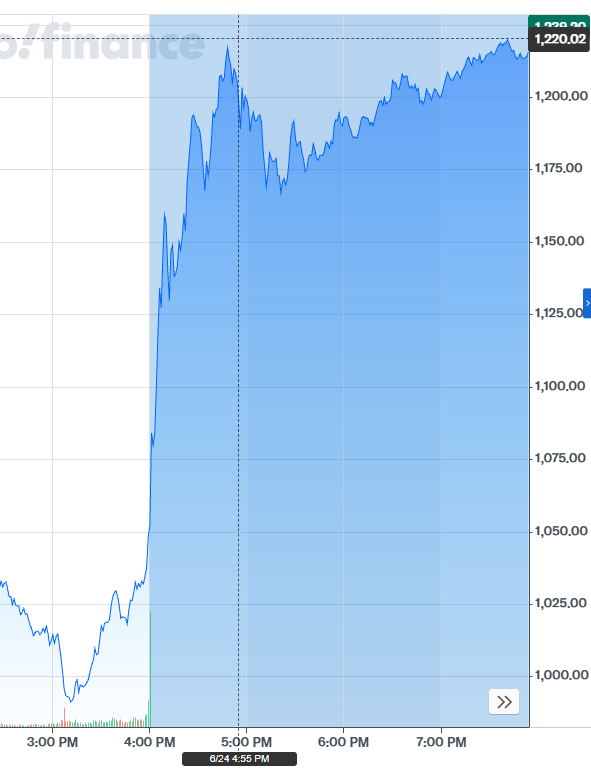
Micron Technology reported fiscal Q3 revenue of $41.46 billion — a 346% year-over-year surge that blew past the $35.84 billion consensus by nearly $6 billion. Adjusted earnings per share came in at $25.11, crushing the $20.20 estimate. But the real fireworks were in the guidance: Micron projected Q4 revenue of $50 billion, a figure that exceeded Wall Street’s $42.9 billion forecast by more than 16%. Shares rocketed 13% in after-hours trading, dragging the entire semiconductor complex higher with it. The VanEck Semiconductor ETF (SMH) jumped 3%, and the Roundhill Memory ETF (DRAM) surged 10%.
After two brutal sessions that had put the entire AI investment thesis on trial, Micron’s verdict was unequivocal: the buildout is accelerating, not decelerating.
Index Performance
Rates, Dollar, Commodities
Brent crude closed below $74 per barrel, pressing further toward four-month lows as easing Middle East tensions continued to push energy prices lower. According to the International Energy Agency (IEA), the UAE’s early-June oil exports had recovered to nearly 85% of pre-war levels — a significant milestone in the normalization of Gulf supply.
President Trump added another layer on social media, declaring that Iran has been notified it cannot charge tolls, insurance fees, or any other levies on vessels transiting the Strait of Hormuz, warning that “if this turns out to be false, negotiations will end immediately.”
The decline in oil contributed to a favorable inflation backdrop heading into Thursday’s PCE release. Bond yields edged lower: the 10-year Treasury ticked down to around 4.48%, offering modest relief after days of upward pressure.
Micron: The AI Trade Gets Its Lifeline
CEO Sanjay Mehrotra’s message on the earnings call was sweeping in scope and unambiguous in tone. Memory, he argued, is no longer a cyclical commodity — it is a strategic asset in the age of AI.
Micron disclosed that it has entered into 16 Strategic Customer Agreements (SCAs), each spanning three to five years, with remaining performance obligations exceeding $5 billion. These long-term contracts represent a structural shift in how memory is sold: from spot-market volatility to locked-in, infrastructure-grade supply arrangements that resemble the kind of deals cloud providers sign with chipmakers.
Mehrotra laid out the broader thesis in plain terms. The AI-driven transformation of memory is still in its earliest stages. Robotics, humanoid systems, and fully autonomous vehicles represent massive untapped demand vectors for memory and storage. Supply shortages, he said, will persist — customers are now acknowledging that it will take considerable time for the industry to close the gap between supply and demand. New fabrication facilities are large, complex, and slow to build. Even with aggressive expansion, Micron expects supply constraints to ease only gradually by 2028, with no clear timeline for when capacity will fully catch up.
The quarterly numbers backed up the narrative. Cloud Memory Business Unit revenue hit a record $13.8 billion — 33% of total company revenue — with gross margins of 83% and operating margins of 78%. Company-wide gross margin more than doubled year-over-year, and the Q4 guidance of approximately 86% gross margin would set yet another record.
Broadcom and OpenAI Unveil Jalapeño
In another development that reshapes the AI chip landscape, OpenAI and Broadcom jointly unveiled Jalapeño — OpenAI’s first custom-designed AI inference processor. The chip was designed from scratch in just nine months, with OpenAI’s own AI models assisting in the development process.
Broadcom CEO Hock Tan stated that Jalapeño delivers performance on par with Nvidia’s Blackwell and Google’s TPU, positioning it as a credible alternative for large-scale LLM inference. Engineering samples are already running ML workloads including GPT-5.3-Codex-Spark at production-target frequency and power, with initial deployment planned by the end of 2026 through gigawatt-scale data centers built with Microsoft and other partners.
The strategic implications are significant. By building its own inference silicon, OpenAI is vertically integrating deeper into the compute stack — a move that could reduce its dependence on Nvidia’s GPUs and fundamentally change the unit economics of serving AI at scale. For Broadcom, the partnership cements its role as the go-to fabrication partner for hyperscalers building custom AI silicon, extending a playbook that began with Google’s TPU program.
Alphabet Joins the Dow
In a historic reshuffling, the Dow Jones Industrial Average announced that Alphabet will replace Verizon effective before the opening of trading on June 29. The addition brings the number of Magnificent Seven constituents in the 30-stock index to five — alongside Microsoft, Apple, Amazon, and Nvidia. Only Meta and Tesla remain outside the Dow.
The move reflects the broader reality of where market capitalization and economic influence now reside. Alphabet’s stock, trading near $350, carries roughly seven times the price weight of Verizon’s ~$47, which will meaningfully alter the Dow’s sensitivity to moves in Big Tech.
Under the Surface: Broader Market Holds Up
While the headline indices suggested weakness, the session’s internals told a different story. A majority of S&P 500 constituents actually finished higher on the day, with the sell-off once again concentrated in a narrow band of large-cap technology names.
Falling oil prices fueled a sharp rally in travel-related stocks: the NYSE Arca Airline Index has surged 5.2% over the past five trading days, while Expedia and Booking Holdings posted strong gains. Consumer staples, healthcare, and utilities all closed in the green, continuing a defensive rotation that has characterized the past several sessions.
The pattern is now unmistakable. The market isn’t breaking down — it is rotating. Capital is flowing out of the most crowded AI trades and into cyclicals, defensives, and value names that benefit from lower energy costs. Whether this rotation deepens or reverses will depend heavily on two things: Thursday’s PCE print and how the market digests Micron’s blockbuster guidance when regular trading resumes.
Bottom Line
Micron’s after-hours explosion answered the question that Tuesday’s semiconductor carnage had posed: is the AI infrastructure buildout running out of steam? The answer, at least from the world’s largest memory maker, is an emphatic no. Revenue that quadrupled year-over-year, 16 multi-year supply agreements, and a Q4 forecast that made Wall Street’s consensus look timid — this was not the report of a company seeing demand plateau.
Combined with Broadcom and OpenAI’s Jalapeño unveil, the day painted a picture of an AI ecosystem that is deepening and diversifying, not contracting. The sell-off that started in Seoul may prove to have been the stress test that set the stage for the next leg higher — provided Thursday’s inflation data doesn’t rewrite the script.
Leave a Reply