The AI boom’s bill is arriving — and it’s being forwarded to everyone who buys a laptop, tablet, or game console.
Markets opened Thursday on a wave of optimism. Micron’s blowout earnings had landed the night before, the S&P 500 jumped 0.8% at the open, and for a brief, hopeful window it looked like the four-day tech sell-off was over. Then Apple announced price hikes of up to $300 across its Mac and iPad lineup, citing a memory chip shortage it called unprecedented. Hours later, Microsoft followed with Xbox console increases of up to $150. By the close, Apple had shed 6% — its worst single-day decline since 2019 — and the Nasdaq extended its losing streak to four consecutive sessions for the first time since February.
The session crystallized a paradox that will define the AI trade for the rest of the year: Micron’s record margins are someone else’s cost crisis. The same memory shortage minting billions in profit for chipmakers is now squeezing consumer electronics companies hard enough to force mid-cycle price increases that haven’t been seen in decades.
Index Performance
Rates, Dollar, Commodities
The May PCE report — the Fed’s preferred inflation gauge — landed before the opening bell and largely confirmed what markets feared. Headline PCE rose to 4.1% year-over-year, the highest since April 2023 and up from 3.8% in April. Core PCE, stripping out food and energy, climbed to 3.4% annually, the hottest reading since October 2023 and a tick above the 3.3% consensus.
Yet beneath the alarming headline, there were subtle signs that the worst may be passing. Energy prices, which drove the bulk of the acceleration through the Iran war period, have begun to retreat as the Strait of Hormuz reopens and Iranian crude reenters global markets. Several analysts noted that the May print likely represents the peak of this inflation cycle, since crude oil’s sharp June decline won’t appear in the data until next month’s release.
Consumer spending, meanwhile, remained remarkably resilient. Personal consumption expenditures rose 0.7% for the month, beating the 0.6% forecast, while personal income also climbed 0.7% — well above the 0.4% expected. The personal saving rate held at 3.0%. Consumers are still spending, but they’re paying more for the privilege and saving less to do it.
Separately, the first-quarter GDP estimate was revised upward to 2.1% annualized from 1.6%, a meaningful 0.5 percentage-point improvement. Durable goods orders fell 4.5% in May, and initial jobless claims dropped to 215,000 — better than the 223,000 expected.
Treasury yields eased modestly after the data, with traders slightly trimming September rate hike odds. The 10-year yield slipped to around 4.45%.
Apple: “We Have Never Seen Anything Like This”
Apple’s announcement landed at market open and immediately reshaped the session’s trajectory. The company raised prices across virtually every hardware category except the iPhone:
The MacBook Neo jumped from $599 to $699. The MacBook Air (512GB) rose from $1,099 to $1,299. The MacBook Pro (1TB) climbed from $1,699 to $1,999. The entry-level iPad went from $349 to $449, and the iPad Mini added $100 to reach $599. Even the Apple TV, HomePod, and Vision Pro saw increases of $70, $50, and $200, respectively.
“The rapid expansion of AI data centers has created an extraordinary surge in demand for memory and storage,” Apple said in a statement. “We have never seen a component price increase this much, this quickly.”
The writing had been on the wall. CEO Tim Cook told the Wall Street Journal on June 17 that the situation had become “unsustainable,” describing the semiconductor market as experiencing a “hundred-year flood.” Counterpoint Research estimates that the higher component costs could add roughly $200 per iPhone for Apple, with price increases of $150 to $200 expected across the lineup when new models launch this fall. According to Everstream Analytics, data centers are now consuming approximately 70% of all memory chips produced globally in 2026, diverting supply away from consumer devices at an unprecedented rate.
Shares fell 6.21% — the stock’s steepest single-day decline in over six years — erasing roughly $260 billion in market capitalization.
Microsoft Follows: Xbox Up $100–$150
Hours after Apple’s announcement, Microsoft disclosed that Xbox console prices would rise worldwide starting August 1. The Xbox Series S (512GB) will increase by $100 to $499.99, while the Series X (1TB) will climb $150 to $799.99. Microsoft is also discontinuing the 2TB model entirely.
“Console storage and memory prices have increased by more than 2.5x and we expect another doubling by the fall of 2027,” Microsoft said on Xbox Wire. The company was unusually candid about the economics: unlike phones, computers, and speakers, consoles are typically sold below manufacturing cost. That business model becomes untenable when the components inside them are repricing at this speed.
Microsoft shares fell 3.5% on the day.
Micron: The Mirror Image
On the other side of the same trade, Micron Technology soared 15.7% — its best day in years — as the market rewarded the blowout fiscal Q3 results reported the previous evening. SanDisk surged 22%, Applied Materials jumped 13.4%, Qualcomm gained 4% after raising its non-handset revenue guidance through fiscal 2029, and Western Digital added 4.9%.
The juxtaposition was impossible to miss. Micron’s record 83% gross margin in its Cloud Memory unit is the direct arithmetic consequence of the same shortage that just forced Apple to raise MacBook prices by $300 and Microsoft to push Xbox consoles to $800. It is the same supply-demand imbalance viewed from two sides of the transaction.
This dynamic — what some analysts are calling the “AI memory tax” — is now the central tension in the technology sector. Every dollar of excess profit at Micron, SK Hynix, or Samsung’s memory division represents a dollar of margin compression at Apple, Microsoft, Sony, and every other company that buys their output. The question for investors is not whether this tension resolves, but when — and Micron’s earnings call offered a clear answer: not soon. CEO Sanjay Mehrotra said supply constraints will persist through at least 2028.
The Broader Market: Quietly Strong
While the Nasdaq grabbed headlines with its fourth straight decline, the broader market told a different story. The Dow Jones Industrial Average rose 0.14% to 51,920.62, touching a new all-time intraday high before settling back slightly. Healthcare, financials, and industrials led the advance: Caterpillar surged 6.1%, Merck gained 4%, UnitedHealth added 2.4%, and Johnson & Johnson climbed roughly 1%.
The divergence between the Dow and the Nasdaq has become one of the defining features of this market. The Dow, with its heavier weighting toward industrials, healthcare, and financials, is benefiting from the rotation out of technology. The Nasdaq, loaded with the hyperscalers and consumer tech companies now absorbing higher memory costs, cannot escape the gravitational pull of the AI cost squeeze.
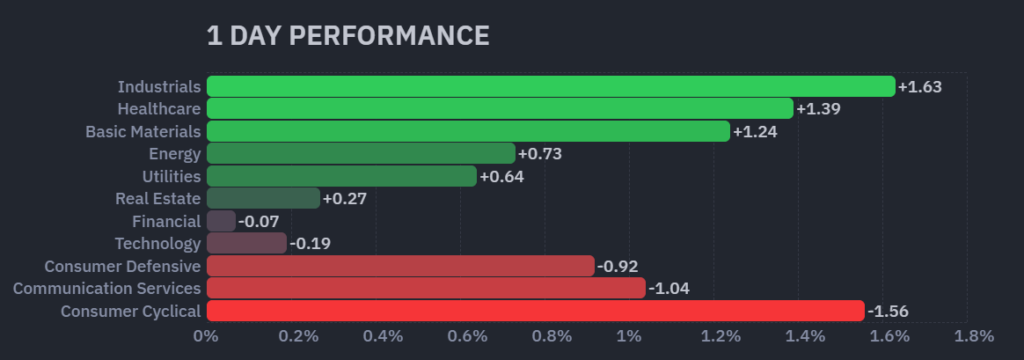
Six of eleven S&P 500 sectors finished higher on the day. The sell-off remains narrow, concentrated in a handful of megacap names. The equal-weight S&P 500 continues to outperform its market-cap-weighted counterpart — a sign that the average stock is doing fine even as the largest ones stumble.
Bottom Line
Thursday distilled the AI investment cycle into a single trading session. Micron’s record earnings are proof that AI infrastructure demand is accelerating. Apple’s price hikes are proof that the cost of that acceleration is now flowing downstream to every consumer who buys a device with memory inside it. Both things are true at the same time, and investors are being forced to pick a side.
For now, the market is choosing breadth over concentration. Defensives, industrials, and value stocks are absorbing the capital fleeing Big Tech. The Dow is at an all-time high while the Nasdaq posts its longest losing streak in four months. That divergence can persist — the fundamental rotation has real earnings support — but it won’t last forever. At some point, either memory prices normalize and the consumer tech squeeze eases, or the downstream cost pressure begins to dent consumer spending in ways that ripple back through the entire economy.
The PCE data suggests we haven’t reached that point yet. Consumers are still spending. But at a 3.0% saving rate and 4.1% inflation, the runway is getting shorter.
Leave a Reply