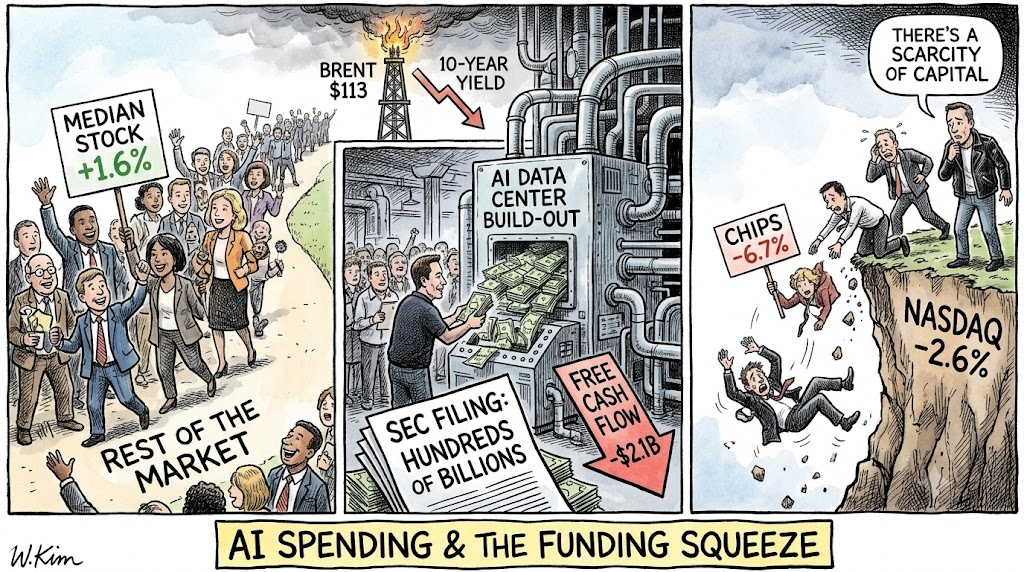
AI spending fears pushed the Nasdaq Composite down −2.60% on Thursday, its worst day since June, after Meta Platforms disclosed how much money it may need to raise for its data center build-out. The Philadelphia Semiconductor Index fell −6.72%, and Meta itself dropped −6.98%.
The rest of the market had a good day. Of the 503 members of the S&P 500, 336 rose, the median stock gained +1.6%, and the equal-weight version of the index finished higher while the standard index lost −1.21%. Treasury yields posted their largest one-day drop in more than three years, and Brent crude closed above $113 on reports that the U.S. and Israel are planning new strikes on Iran.
Index Performance
Cross-Asset Snapshot
Meta’s Filing Turns AI Spending Fears Into a Funding Question
The S&P 500 closed at 7,663.43 and the Nasdaq Composite at 26,008.86. The Nasdaq 100 fell −2.90%. The Dow edged up +0.02% to 52,867.98, and the Russell 2000 gained +0.11%. The selling in tech never let up. The Nasdaq Composite opened about 1.3% lower and kept sliding until mid-afternoon, touching −2.86% around 3 p.m. before a small recovery into the close.
Meta’s third-quarter numbers, released Wednesday evening, were strong on revenue. The trouble was in the paperwork filed alongside them. A preliminary information statement Meta filed with the SEC on Wednesday, tied to its plan for a new class of nonvoting Class C shares, describes three long-range forecasts that management presented to the board in May. In each case, the filing says, the forecasts showed the company would need to raise “hundreds of billions of dollars” over several years, starting as early as this fall, according to the document.
That turned the Class C plan into something investors had to price differently. On Wednesday night, the new shares looked like a two-for-one split. By Thursday morning, they read as a way to sell stock without diluting Mark Zuckerberg’s voting control. The filing also noted that large capital raises by Alphabet and SpaceX, and expected fundraising by Anthropic and OpenAI, had made the environment for raising money harder, so Meta wanted to move before competitors absorbed the available capital, The Wall Street Journal reported.
Other details added to the concern. Meta’s free cash flow turned negative for the first time since it went public, and its future spending commitments, including data center construction and leased computing capacity, rose to about $825 billion from nearly $700 billion in July, according to the Journal. Meta lost about $124 billion in market value on the day and closed at $648.85.
Meta’s own filings show how quickly the cushion disappeared. Capital spending, including principal payments on finance leases, reached $34.9 billion in the third quarter, about 80% more than a year earlier, while operating cash flow grew only 9% to $32.8 billion. Free cash flow went from $10.6 billion a year ago to $0.8 billion in the second quarter and −$2.1 billion in the third, based on the cash flow statements in Meta’s quarterly reports.
The reaction stands in contrast with SpaceX’s report two days earlier. SpaceX spent $19.6 billion on capital projects in its third quarter, and its shares rose +7.79% the next day. SpaceX paired that spending with its first profit as a public company and $7.56 billion of revenue from renting computing capacity, so investors could see the spending turning into sales. Meta’s spending now exceeds the cash its business produces, and its filing says the gap will be filled with outside money. To a supplier, a customer that pays for its data centers out of its own cash is a source of orders. A customer that needs to raise hundreds of billions of dollars competes with every other AI borrower for the same pool of capital, and its orders depend on how that competition goes. That is why the selling reached Nvidia, Lam Research and the neoclouds along with Meta.
Nvidia’s chief executive added to the unease a few hours later. Speaking to CNBC at the company’s GTC conference in Berlin, Jensen Huang said demand for neoclouds, the companies that rent out AI computing capacity, is “off the charts,” but that the capital needed to fund it is falling short. Because demand is so high across AI, “there’s a scarcity of capital,” he told CNBC, adding that the problem would get solved. Coming the morning after Meta’s filing, the comment confirmed what the market was worried about rather than easing it. Nvidia fell −4.40% and CoreWeave −10.06%.
There was one quiet spot, the credit market. CoreWeave’s bonds due in 2032 traded just under 80 cents on the dollar, only slightly below Wednesday’s level, according to MarketAxess data cited by the Journal. Last week, the debt of the most leveraged AI companies was where the stress showed first. On Thursday, the selling stayed in stocks.
Chip Stocks Give Back Wednesday’s Rebound and More
Wednesday’s rally in AI hardware, covered in yesterday’s recap, lasted one session. The Philadelphia Semiconductor Index lost −6.72% to 10,731.98, more than wiping out Wednesday’s +1.96% gain, and the VanEck Semiconductor ETF (SMH) fell −5.99%. Among large chipmakers, Marvell dropped −8.70%, AMD −8.10%, Intel −8.04% and Micron −6.26%. Broadcom lost −4.31%.
Chip equipment makers fell even harder, led by Lam Research. Lam dropped −11.76% a day after reporting record revenue of $8.22 billion and a December-quarter forecast of $8.60 billion that topped estimates. Finance chief Doug Bettinger said the forecast “would have been a bit higher if not for some near-term supply chain constraints,” Yahoo Finance reported. Teradyne fell −10.63%, KLA −9.55% and Applied Materials −8.16%.
Lam’s comment mattered beyond Lam. For a market that pays for AI suppliers on the assumption that their growth is limited only by demand, a supplier saying it could have sold more if it had the parts is a reminder that physical bottlenecks can cap results too. The same reasoning spread to optical networking, power equipment and data center cooling. Coherent fell −12.51%, Lumentum −11.54% and GE Vernova −10.64%. Bloom Energy lost −8.70% ahead of its results and Vertiv −7.81%.
The split inside the power trade was sharp. Utilities as a sector rose +1.9%, yet the independent power producers that have been bought as AI electricity suppliers fell with tech: Vistra lost −9.81%, Constellation Energy −5.74% and NRG −5.43%. Amphenol and Corning, which supply connectors and fiber to data centers, both dropped more than 7%.
The funding question also reached Asia overnight. SK hynix said on Friday in Seoul that it had stopped reviewing a U.S. listing of Solidigm, its NAND flash and data center SSD subsidiary, citing capital market conditions, Seoul Economic Daily reported. A Nasdaq IPO raising $10 billion to $15 billion had been expected as early as next year, with some estimates valuing Solidigm at up to $150 billion. A pre-IPO funding round has now been halted as well. Korean regulators had objected to the plan under new rules on duplicate listings, and SK hynix shareholders feared dilution, so markets were not the only reason. Even so, one of the largest planned listings tied to AI storage demand was shelved in the same week that investors began asking how the build-out will be paid for. The broader story will be covered in this week’s weekly recap.
The Index Fell, but the Typical Stock Rose
Thursday’s decline was narrow even by the standards of this month. The median S&P 500 stock rose +1.64%, and the simple average of all 503 members gained +0.74%. The Invesco S&P 500 Equal Weight ETF (RSP) rose +0.73% while the SPDR S&P 500 ETF (SPY) fell −1.18%. That 1.91-point gap is the widest daily outperformance for the equal-weight fund since July 11, 2024, based on daily closing prices for the two ETFs since the start of 2024.
The losses came from a handful of very large companies. Using the market values in the S&P 500 map, the ten largest index members, counting Alphabet’s two share classes separately, account for more than four-fifths of the day’s decline. Nvidia alone accounts for about a fifth. The other 493 members rose +0.82% on average.
Consumer staples led the sectors. The Consumer Staples Select Sector SPDR (XLP) gained +3.31%, its best day since April 9, 2025, the day the White House paused most of its new tariffs and nearly everything rallied. This time, staples rose while the Technology Select Sector SPDR (XLK) fell −3.29%. The 6.6-point gap between the two funds was among the five widest since the start of 2024. General Mills rose +8.01%, Kraft Heinz +6.77%, Procter & Gamble +5.58% and Kimberly-Clark +5.32%.
Lower bond yields helped the rate-sensitive parts of the market. Lennar gained +8.69%, D.R. Horton +6.25% and PulteGroup +5.84%. Software stocks, which had been left behind as money flowed into AI hardware, also rose: Adobe gained +6.07%, Intuit +5.75% and Salesforce +3.52%.
Thursday also reversed Wednesday’s rotation almost exactly. Sorting S&P 500 stocks by their performance last week, the worst fifth, which fell an average of 10.4% that week, rose +1.86% on Wednesday and fell −4.23% on Thursday. The best fifth slipped −0.41% on Wednesday and jumped +3.12% on Thursday. Across all stocks, Thursday’s moves were negatively correlated with Wednesday’s, at about −0.51.
Two days of rotation in opposite directions point to positioning more than to new information about the economy. Investors are moving large amounts of money between the same two groups of stocks, and each new data point on AI spending sends it the other way. Meta’s filing gave the sellers of AI hardware a reason to return within a day.
Oil Climbs on Reports of New Strikes on Iran
Brent crude rose +4.0% to settle at $113.17 a barrel, its highest close since May 4, and December WTI gained +2.4% to $99.47, CNBC reported. The gap between the two benchmarks widened to about $13.70.
The New York Times reported, citing unnamed U.S. officials, that the U.S. and Israeli militaries have drawn up plans for renewed strikes on Iran after the November 3 midterm elections, describing a short but intensive operation. Neither government has confirmed the plans. President Trump told reporters late Wednesday that the U.S. is not negotiating with Iran and that something would happen “fairly soon,” while suggesting most people expect it after the election.
The Persian Gulf also became more dangerous. The State Department ordered non-emergency staff and their families to leave Saudi Arabia, citing Houthi attacks on civilian targets, including a strike on the airport in Dammam that killed at least two people, according to CNBC. Saudi Aramco told staff to evacuate its Dhahran headquarters and work remotely, and Iran’s Revolutionary Guard navy said it had hit four vessels in the northern Gulf while three others struck mines west of the Strait of Hormuz, Reuters reported.
Energy stocks did not follow crude. The S&P 500 energy sector fell −0.75%, with oil services companies among the weakest: Baker Hughes lost −4.25%, SLB −3.03% and Halliburton −2.35%. Exxon Mobil and Chevron were roughly flat. Energy had been one of the main shelters during last week’s chip selloff, and on Thursday investors moving out of AI chose staples, health care and utilities instead.
Treasurys Rally, and Rate Hike Odds Fall
Bonds rallied as investors sold technology stocks. The 10-year Treasury yield settled at 4.952%, down from 5.145% on Wednesday, according to Tradeweb data cited by the Journal, its largest one-day drop since March 2023 and its first close below 5% in a month. The two-year yield fell 0.188 percentage point to 4.635%, its biggest one-day decline in more than a year, and the 30-year yield dropped 0.151 point to 5.286%, the Journal reported.
Europe went the other way. France’s 10-year yield reached its highest level since 2002 on concerns about the country’s budget deficit, according to the same report, while U.S. and German bonds attracted buyers looking for safety. The French yield first crossed 5% on Wednesday, as Prime Minister Sébastien Lecornu tries to pass a 2027 budget with €43 billion of spending cuts without a majority in parliament, Euronews reported. On Thursday, the gap over German 10-year yields widened past 160 basis points, the most since November 2011, and the French 10-year yield was roughly level with the U.S. 10-year, according to FXStreet. Belgian and Italian spreads widened as well, and European bank stocks fell.
The next test comes on Friday, when Moody’s is scheduled to review France’s Aa3 rating, which already carries a negative outlook. Most economists expect a downgrade, Euronews reported. Under EU rules, scheduled sovereign rating decisions are published after European markets close, so the first trading reaction will come on Monday. A downgrade would probably widen the French spread further, and if it repeats Thursday’s pattern, more money would move into Bunds and Treasuries, holding U.S. yields down. The risk is contagion: if Italian and Belgian bonds and European banks keep falling with France, the European Central Bank comes under pressure to respond, and the selling could reach other assets. A decision to keep the rating could do the opposite, pulling some of the safety bid out of Treasuries.
The economic data did little to explain the move. Initial jobless claims fell by 6,000 to 194,000 in the week ended October 17, the Labor Department said, and the four-week average stood at 197,750. A labor market that tight would normally support higher yields, not lower ones.
The bond rally changed rate expectations for the Fed. Based on 30-day fed funds futures prices, the implied probability of a quarter-point hike at the October 27-28 meeting fell to about 8% from 16% on Wednesday. The probability of at least one hike by the December meeting dropped to about 80% from 95%.
The odds fell even as oil climbed, which suggests traders were thinking about growth more than inflation. If the largest technology companies slow their spending, the economy loses one of its main sources of investment this year, and the Fed has less reason to tighten.
Gold did not share in the move into safety. December gold lost −2.6% to about $4,041 an ounce, and silver dropped 4.6% to a new low for the year, according to the Journal — a pattern consistent with investors raising cash wherever they still had gains. The dollar index slipped −0.06% to 101.63. Bitcoin fell −3.61% to about $81,390, and the VIX rose +14.09% to 19.03.
Around the Market
Apple was the only Magnificent Seven stock to rise, gaining +1.23%. Meta fell −6.98%, Amazon −4.57%, Nvidia −4.40%, Alphabet −3.15%, Tesla −3.08% and Microsoft −2.23%. Apple’s business does not depend on building data centers, which has made it the big tech stock investors keep when they sell AI.
Tesla’s shares lost ground after the company cut its full-year capital spending forecast to about $20 billion from more than $25 billion, Investing.com reported. For a company valued on robots and self-driving cars rather than car sales, a smaller budget was read as slower progress, and the company also pushed back the timelines for outside Optimus deliveries and meaningful robotaxi revenue. Meta was punished for planning to spend too much, Tesla for planning to spend too little. SpaceX fell 9.1%, according to the Journal.
Procter & Gamble gave staples their biggest single push. Quarterly sales rose 4% to $23.3 billion, organic sales also grew 4%, and core earnings came in at $2.00 a share, the company said. P&G raised its forecast for all-in sales growth to 2% to 4%, though the increase reflects its acquisition of Thorne. The organic sales forecast of 1% to 3% and the earnings outlook were unchanged.
Moderna fell −17.57% after partial results from its personalized melanoma vaccine with Merck leaked ahead of their scheduled release. The full data, published later Thursday, showed the vaccine combined with Keytruda cut the risk of recurrence or death by 42% compared with Keytruda alone, CNBC reported. Analysts called the results clinically meaningful and blamed the selloff on expectations, as the stock had risen more than 530% this year. Merck fell −1.76%.
Lockheed Martin rose +6.96%. Third-quarter sales grew 11% to $20.7 billion, backlog reached a record $292.0 billion including a $52.5 billion multiyear award for PAC-3 interceptors, and the company raised its full-year sales, earnings and cash flow guidance, its release showed. Blackstone gained +8.38% after reporting distributable earnings of $1.32 a share and $63.3 billion of inflows, the firm said. Spotify rose about 11% after adding 6 million premium subscribers to reach 306 million, one million above its own forecast, according to its report.
After the close, two AI suppliers fell despite beating estimates. Western Digital reported revenue of $4.38 billion, up 55%, and guided above expectations, while Bloom Energy’s revenue rose 139% to $1.24 billion and it raised its full-year earnings outlook, TipRanks reported. By 7:10 p.m., Western Digital was −5.2% below its regular-session close and Bloom −6.0%. Both had briefly traded about 4% higher right after their releases. Deckers Outdoor was down −6.9%. The broader after-hours market was calm, with the iShares Semiconductor ETF (SOXX) −0.43% and the Invesco QQQ Trust −0.16%.
My Take
Dealers were short gamma on Thursday, and the selling accelerated. In the premarket, futures simply followed Asia lower and kept falling, without even a dead-cat bounce.
I said Meta would matter, and it did. The earnings were fine, but I didn’t expect talk of more spending to set off a reaction like this, especially after the market cheered SpaceX’s spending plans two days ago. I find it hard to make sense of.
I can’t gauge where Nasdaq 100 futures go from here, so I’m only reacting. The selling in tech and the French-led selloff in eurozone bonds seem to have pulled U.S. yields lower, and money moved into the parts of the market that had been left behind, so this looks like rotation to me. For now I’ll approach NQ carefully and pay more attention to the S&P 500 futures. I plan to watch both and trade whichever is stronger.
December Nasdaq 100 futures reopened at 6 p.m. Wednesday about 0.45% below their 4 p.m. level and fell through the Asian and European sessions, reaching −1.92% by 6 a.m. ET. Japan’s Nikkei 225 closed −2.74% and South Korea’s Kospi −2.97% on Thursday. The largest rebound from a running low during the regular session was about 0.5%, and the contract hit its low of 29,033 at 3:45 p.m., −3.38% below Wednesday’s 4 p.m. price. S&P 500 futures fell less than half as much, ending the cash session −1.26% lower against −3.00% for Nasdaq 100 futures.
What’s Next
On Friday, American Express and SLB report before the open. S&P Global’s flash purchasing managers’ indexes for October are due at 9:45 a.m. ET, followed by the final University of Michigan consumer sentiment reading at 10 a.m. Moody’s decision on France is expected after European markets close.
Next week brings the Fed’s decision on October 28, at the end of the October 27-28 meeting, along with results from Microsoft and Alphabet. Amazon reports on October 29, the company said. After Thursday, the spending plans of those three companies will be read for what they imply about funding, not only about demand.
Bottom Line
Thursday was a repricing of the AI build-out’s financing, concentrated in the companies that spend on it and the companies that supply it. Meta’s filing put a size on the money the largest spenders may need, and investors sold the whole chain from Meta to Lam Research to the power producers.
Most of the market rose. Staples, health care, banks, homebuilders and software gained, yields fell sharply and the odds of a Fed hike for the October decision dropped to single digits. The index fell because its largest members are the ones tied to AI spending.
The rotation has now switched direction two days in a row. Microsoft, Alphabet and Amazon will show next week whether the funding question stays with Meta or spreads across big tech.
Leave a Reply