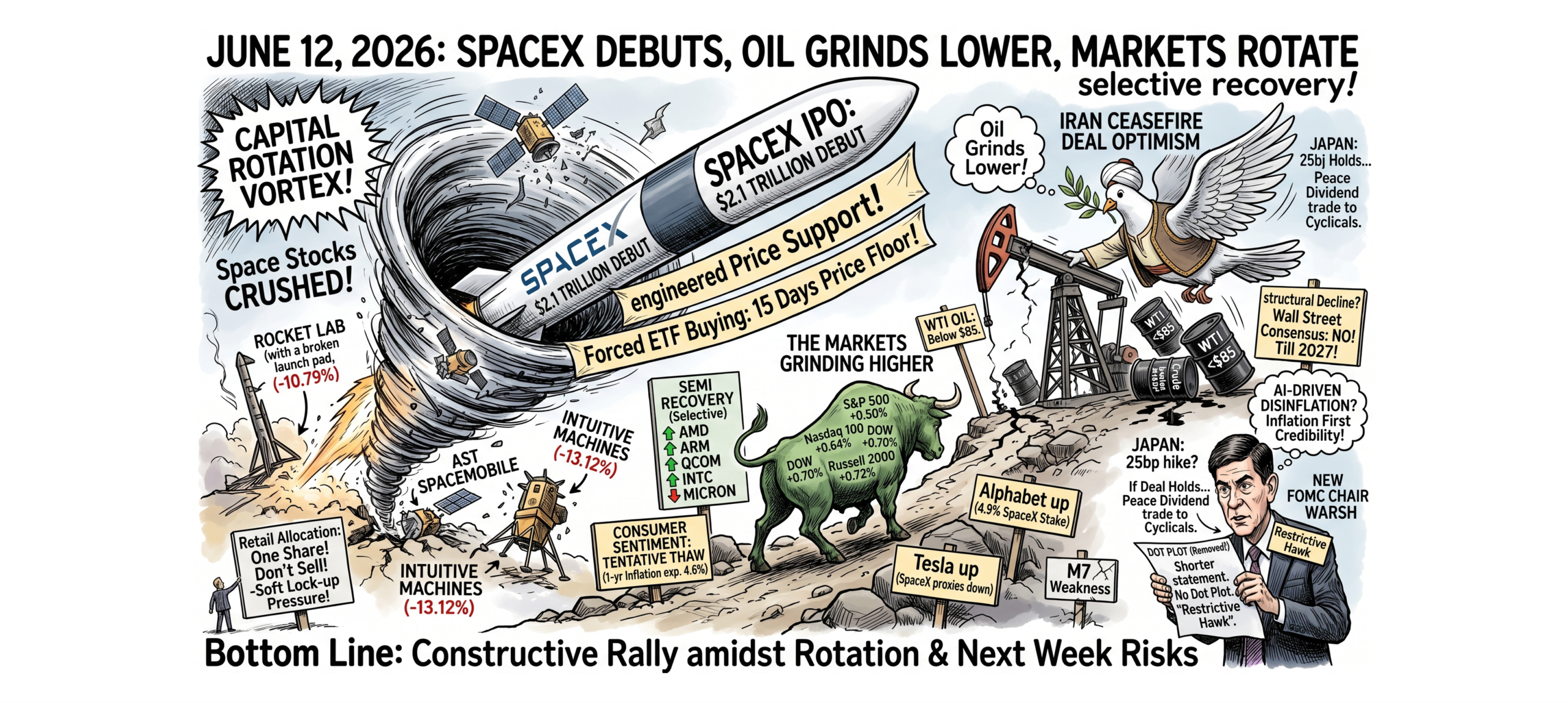
The session on June 12 was defined by two forces pulling in opposite directions: SpaceX’s blockbuster market debut absorbing capital and attention, while Iran ceasefire hopes pushed oil lower and gave equities room to breathe. The result was a broad but measured rally — not euphoric, but constructive.
Index Performance
Rates, Dollar, Commodities
The SpaceX Debut: What Actually Happened
SpaceX priced at $150 and opened the session rocketing to an intraday high of $176.52 — a 31% pop — before settling at $161.11 by close, representing a 7.4% gain over the offer price on volume exceeding 500 million shares. At $2.1 trillion, it debuted as the 7th largest company in the world by market cap.
The debut was anything but organic. The IPO architecture was engineered for price support:
- Roughly 20% of public shares were allocated to retail investors — most receiving just one share — with the explicit intent of prompting them to buy more in the open market.
- Retail allocatees were asked not to sell for 15–30 days. Brokerages including Fidelity made it clear that early sellers could be deprioritized in future IPO allocations — a soft lock-up enforced through social pressure rather than legal obligation.
- The strategic logic: keep retail supply off the market during the window when passive capital is forced to buy. Nasdaq has confirmed SpaceX will be added to the Nasdaq 100 after 15 trading days. At least 25 ETFs — including leveraged and inverse products — have registered SpaceX for inclusion.
The setup is straightforward: mandatory ETF buying provides a price floor for 15 trading days. After that, the fundamental case has to carry the stock on its own — and the valuation concern is real. Dan Niles of Niles Investment has flagged the risk-reward as unfavorable at current prices. The lock-up structure adds another layer of complexity.
SpaceX lock-up schedule — key dates:
- Q2 earnings (post June 30): insiders can sell 20% of holdings. If price holds 30% above IPO for 5 of the next 10 sessions, an additional 10% can be sold.
- Days 70, 90, 105, 120, 135 post-IPO: 7% tranches become available at each interval.
- Q3 earnings (post Sept 30): additional 28% eligible.
- Day 180: full lock-up expiry.
The insider selling schedule is materially more aggressive than the standard 180-day cliff. Worth watching closely as each tranche hits.
Oil Pulls Back on Iran Optimism
Iran’s Foreign Minister stated directly that an MOU agreement is “closer than ever”. A senior Trump administration official put the probability of a deal within days at 80–85%.
WTI dropped below $85 on the news — from $86.42 to $84.29 by session end. But Wall Street is not calling this a structural oil decline. Goldman Sachs expects Middle Eastern crude exports to normalize by late August at the earliest. The broader consensus: energy prices stay elevated through at least early 2027 until meaningful, sustained throughput increases through the Strait of Hormuz are confirmed.
Rates ticked up modestly — the Iran optimism was enough to move oil but not enough to meaningfully shift the rates picture. Gold held near highs, suggesting the market isn’t fully pricing in a clean resolution.
Semis: Selective Recovery
After yesterday’s broad selloff, semis saw rotation back in — but selectively. AMD, Intel, ARM, and Qualcomm led, driven by a wave of analyst upgrades:
- AMD: Upgraded to Buy by Citigroup, citing rising CPU demand and positioning as the #2 GPU supplier.
- Qualcomm: Price target raised from $160 to $230 by Wells Fargo, on expectations of becoming AWS’s custom AI chip partner.
- Micron: Declined 1.43%. Bloomberg reported that major investment banks are flagging stretched valuations in Asian semiconductors and have begun restricting leveraged positioning for hedge funds.
Space Stocks: Sell the News
The SpaceX debut did not lift the rest of the space sector — it crushed it.
- Rocket Lab: -10.79% (despite its own Nasdaq 100 inclusion news on June 22)
- AST SpaceMobile: -15.53%
- Intuitive Machines: -13.12%
Classic capital rotation — money that had been parked in SpaceX proxies moved directly into the real thing. Rocket Lab’s index inclusion announcement, which would normally be a catalyst, was completely overwhelmed by the IPO dynamics. The lesson is familiar: news-driven moves in satellite stocks require an exit before the main event.
Tesla and Alphabet bucked the broader M7 weakness — the latter because it holds a 4.9% stake in SpaceX worth approximately $100 billion at current prices.
Consumer Sentiment: A Tentative Thaw
The University of Michigan Consumer Sentiment Index rose for the first time in four months. One-year inflation expectations declined from 4.8% to 4.6% — modest progress, but directionally helpful ahead of next week’s FOMC.
Next Week: FOMC Under Kevin Warsh & Japan Rate Decision
The first FOMC meeting chaired by Kevin Warsh is the dominant event risk for next week. Evercore ISI lays out the key expectations:
- A shorter, more direct policy statement — less forward guidance, more ambiguity by design.
- Warsh will not submit a dot plot — removing one potential source of market volatility.
- “Restrictive hawk” posture — Warsh is expected to lean on AI-driven disinflation as a counterargument while maintaining his inflation-first credibility.
The risk is binary: too hawkish, and rate hike fears resurface and pressure equities. Too dovish, and the long end of the curve sells off. Evercore expects Warsh to thread the needle — but the first meeting of a new chair always carries headline risk.
Japan is an additional wildcard — a 25bp rate hike to 1.00% is expected next week, which could affect yen dynamics and cross-asset positioning.
Bottom Line
The session was a rotation story more than a directional one. SpaceX absorbed capital from the rest of the space sector and contributed to some M7 pressure, while Iran headlines gave oil bears an opening and kept the broader index bid.
The 15-trading-day window is the key frame for SpaceX: passive buying provides support until the ETF inclusion wave passes, after which the stock has to justify a $2.1 trillion valuation on its own merits. The lock-up schedule makes the back half of this year worth watching carefully.
FOMC next week is the macro event that matters most. Until that’s cleared, expect the range to hold.
Leave a Reply