The week that began with a semiconductor meltdown in Seoul ended with a report that the world’s most anticipated IPO might not happen this year at all.
The New York Times reported Friday that OpenAI is leaning toward delaying its public offering until 2027, citing three people involved in the company’s deliberations. CEO Sam Altman reportedly rejected any valuation below $1 trillion as a “non-starter,” while his advisers warned that SpaceX’s post-debut volatility — a 32% collapse from peak to present within two weeks — had dampened retail enthusiasm for mega-cap tech listings. The news sent a fresh wave of selling through the already-battered chip sector, pushing the Philadelphia Semiconductor Index to a 7.9% weekly loss, its worst since early April.
Yet the session’s damage was remarkably contained. Improving consumer sentiment data and a decline in long-term inflation expectations kept the broader market from cracking, and the S&P 500 finished just 0.05% lower. The rotation out of AI megacaps and into defensives, industrials, and healthcare — the defining pattern of this entire week — held through the final bell.
Index Performance
Rates, Dollar, Commodities
The University of Michigan’s final June consumer sentiment reading provided a modest counterweight to the tech gloom. The headline index rose to 49.5, up roughly 10% from May’s all-time low of 44.8, as falling gasoline prices lifted mood across income, wealth, and political groups.
More importantly for the Fed, long-run inflation expectations dropped sharply. The 5-to-10-year outlook fell to 3.3%, down from the preliminary estimate of 3.4% and from 3.9% in May, returning to pre-Iran-war levels. Year-ahead expectations edged down to 4.6% from 4.8%. The five-year business conditions outlook surged 16%, suggesting consumers are beginning to view the economic damage from the Iran conflict as temporary rather than structural.
The data helped cushion the market’s decline and supported a continued rotation into rate-sensitive sectors and small caps.
OpenAI’s $1 Trillion Standoff
OpenAI’s confidential S-1 filing with the SEC on June 8 had set the stage for what many expected to be the second trillion-dollar tech IPO of the summer, following SpaceX’s record debut. That timeline is now in serious doubt.
According to the Times, OpenAI’s bankers — Goldman Sachs and Morgan Stanley — presented Altman with two options: accept a lower valuation and list by late 2026, or wait until 2027 for a better shot at the $1 trillion target. Altman chose to wait. CFO Sarah Friar, who joined from Nextdoor in 2024, has separately advocated for the 2027 timeline, citing $600 billion in future infrastructure commitments and the difficulty of meeting public-company reporting standards on a compressed schedule.
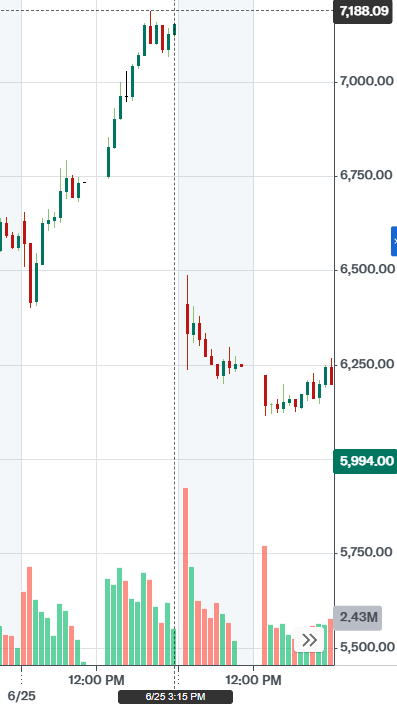
The stakes for SoftBank extend beyond a single day’s loss. The Japanese conglomerate’s $40 billion bridge loan matures in March 2027, and without a successful OpenAI exit, the path to repayment narrows considerably. SoftBank had increasingly positioned its OpenAI stake — expected to reach roughly $65 billion by October — as the crown jewel of its portfolio, helping lift its market value above Toyota’s earlier this year. The delay strips away that near-term catalyst and leaves investors recalculating the holding company’s net asset value with no clear liquidity event on the horizon.
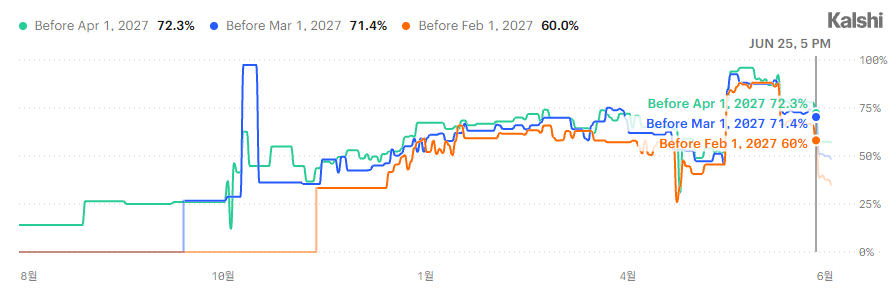
Prediction markets on Kalshi now place 59% odds on an official IPO announcement by March 2027, and 73% by June 2027.
For the chip sector, the delay raised a more fundamental concern: if the company driving more AI infrastructure spending than any other in the world is signaling caution about public market appetite, what does that say about the sustainability of the capex cycle? Micron fell more than 7% on the day, and AMD shed 2.4%.
SpaceX: Index Inclusion Meets Persistent Volatility
SpaceX (SPCX) closed at $153.23 after another session of choppy trading, remaining above its $135 IPO price but well below the $225 intraday peak reached during its euphoric first week. The stock’s trajectory since debut reads like a condensed tutorial in post-IPO reality: a meteoric rise, a bond-sale scare, a three-day rout, a Starfall-launch bounce, and now the gravitational pull of index mechanics.
Friday marked a milestone day on that front. FTSE Russell added SpaceX to its U.S. equity indexes after the close, with the changes going live for trading on Monday, June 29. Approximately $6 billion in market-on-close (MOC) orders flooded the session as passive funds benchmarked to the Russell 1000 rebalanced their portfolios to accommodate SpaceX’s entry. The Russell reconstitution alone is estimated to generate $22 to $27 billion in mechanical buying over the near term.
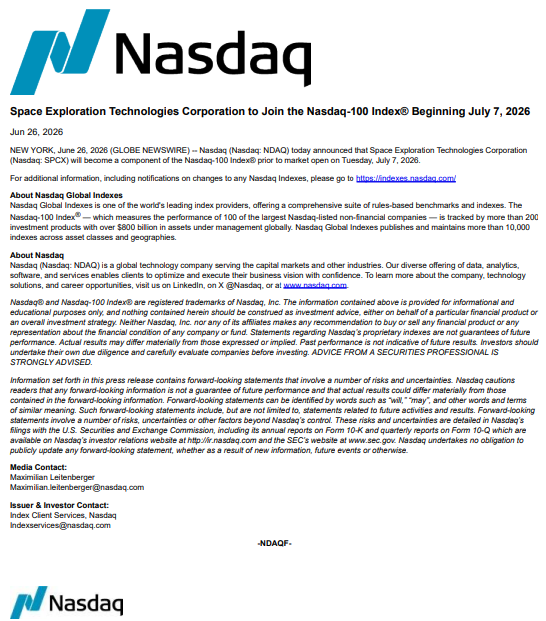
That is only the first wave. Nasdaq confirmed on Friday that SpaceX will join the Nasdaq 100 before market open on July 7, making it one of the first beneficiaries of Nasdaq’s fast-track inclusion framework for newly public companies. J.P. Morgan estimates the addition could drive $4.3 billion in passive fund inflows from QQQ and QQQM alone. With more than $800 billion tracking the Nasdaq 100, even a sub-1% index weight creates significant demand for a stock with limited free float.
SpaceX also received regulatory approval to acquire Mesh, a startup founded by a former SpaceX engineer, further expanding its technology footprint. Yet investors continue to grapple with the fundamental valuation question: the company reported a $4.9 billion loss in 2025 and remains ineligible for S&P 500 inclusion under that index’s profitability requirements. Supporters counter that SpaceX is positioned to dominate satellite internet, AI compute infrastructure, and commercial launch — three markets expected to define global infrastructure for the next decade.
Moderna Surges to Highest Since 2024
In one of the session’s brightest spots, Moderna (MRNA) surged approximately 15% to around $69, hitting its highest level since 2024 and capping a roughly 48% rally from its early-June lows near $46.
The catalyst was twofold. First, an FDA advisory committee voted 9-0 that Moderna’s mRNA-1010/mFLUSIVA flu vaccine has a favorable benefit-risk profile in adults 50 and older, all but guaranteeing approval ahead of the August 5 PDUFA date. Second, the company’s Science Day on June 25 showcased a dramatically expanded pipeline stretching into oncology, autoimmune disease, and rare disorders — including in vivo CAR-T and T-cell engager programs. Moderna also announced plans to invest in German manufacturing sites, including potential acquisitions of BioNTech facilities slated for closure.
Management restructured the company into three commercial franchises — infectious disease, oncology, and rare diseases — positioning for multiple product launches in 2027–2028. Analysts remain divided on near-term revenue timing, but the market is clearly repricing Moderna as a platform company rather than a one-product story.
The Broader Tape: Rotation Holds
Apple recovered modestly from Thursday’s 6% plunge, and the broader market outside of technology and communication services continued to show resilience. Healthcare stocks led again, with the sector extending its run as the week’s top performer. The Dow’s marginal 0.09% decline on Friday masked a week in which the blue-chip index significantly outperformed the Nasdaq by over 4 percentage points.
The weekly scorecard tells the rotation story in stark terms. The Nasdaq lost 4.7%. The S&P 500 shed 2.05%. The SOX dropped 7.9%. Yet the Russell 2000 held up far better, and defensive sectors posted gains. This is not a market that is breaking — it is a market that is re-sorting itself, moving capital from the AI hyperscaler complex into everything else.
Bottom Line
This was the week the AI trade’s contradictions came into full view. Micron proved that memory demand is accelerating, but Apple and Microsoft proved that the cost of that demand is flowing downstream to consumers. OpenAI’s potential IPO delay proved that even the most powerful AI company in the world isn’t confident that public markets will pay what it thinks it’s worth. And SpaceX’s journey from $225 to $153 in two weeks proved that even record-breaking debuts are subject to gravity.
The semiconductor index’s 7.9% weekly decline — its worst since April — captures the mood. But the market’s internal breadth tells a more nuanced story: the average stock had a far better week than the megacap leaders. As SpaceX enters the index era next week and Micron’s guidance begins to reshape earnings models across the chip sector, the question isn’t whether AI spending continues. It’s whether the market has already priced in too much of the upside — and whether the downstream costs are just beginning to be counted.
Leave a Reply