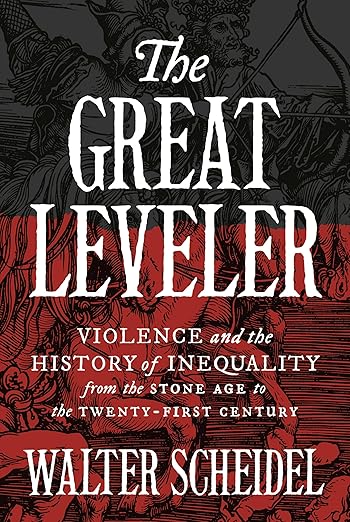
Walter Scheidel | History / Economics | Read: September–October 2023
Note: Section summaries in this review are based on my own reading notes from the original text.
How I Found It
In 2023, something felt off.
Inflation had already eaten through the previous year. Interest rates were climbing. In March, Silicon Valley Bank collapsed. Then Credit Suisse. By October, a war had broken out between Israel and Hamas. The crisis never quite felt over — it just kept shapeshifting.
What bothered me most wasn’t the volatility itself. It was the pattern underneath it. Every time inflation surged, I watched it play out the same way: workers on wages got squeezed, their purchasing power eroding month by month, with no slack to save or invest. Meanwhile, those who already held assets — real estate, equities, capital — barely flinched. Some even gained.
I wanted to understand this at a deeper level. Not just why inequality exists in the present, but what it is, where it comes from, and whether it can ever be overcome. That search led me to Walter Scheidel’s The Great Leveler.
What It’s About
Scheidel’s argument is both simple and devastating: throughout all of human history, significant reductions in economic inequality have been caused by only four forces — mass mobilization warfare, transformative revolution, state collapse, and catastrophic plague. He calls them the Four Horsemen of Leveling.
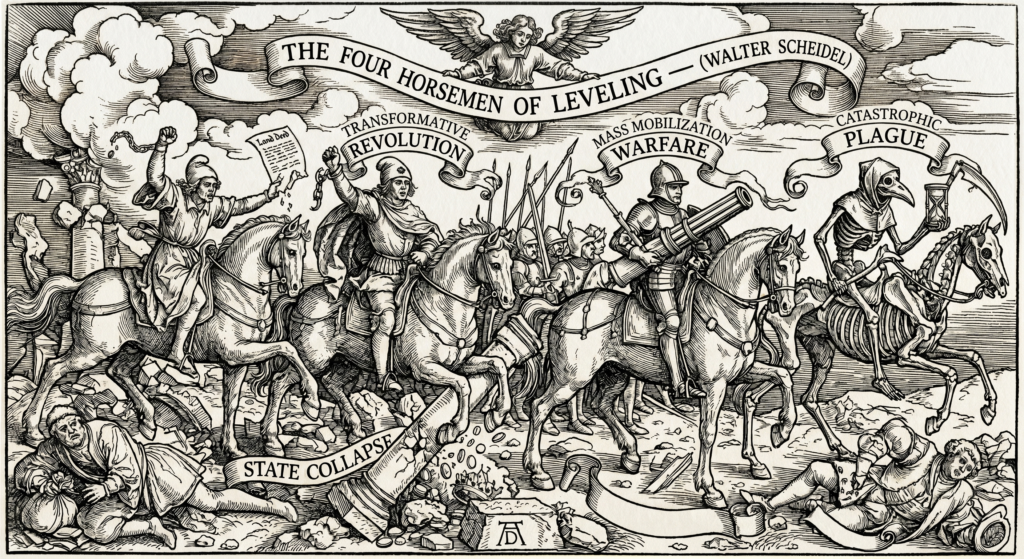
Everything else — land reform, democracy, education, economic growth — has produced, at best, temporary or marginal relief. Without violent shock, inequality tends to rise. Always has. Probably always will.
The book covers an astonishing range: from hunter-gatherer societies and ancient Rome, through the Black Death and the World Wars, to Soviet collectivization and contemporary wealth concentration. The evidence just keeps building.
What I Expected vs. What I Got
I came in hoping for a diagnosis with a cure. I left with a diagnosis and no cure.
Scheidel doesn’t argue that inequality is good. He argues that the mechanisms capable of reducing it at scale are almost invariably catastrophic — and that peaceful alternatives have repeatedly failed to sustain themselves. Tax reform fades. Land redistribution gets reversed. Democracies get captured by wealth. Economic growth creates new concentrations even as it lifts average incomes.
The most unsettling section for me was on peaceful alternatives — Chapter 12 and beyond. Every “this time it’s different” argument gets systematically dismantled. Nordic social democracy? Built on the back of wartime mobilization and fiscal structures that emerged from crisis. Latin American redistribution experiments? Temporary, fragile, frequently reversed.
What stays with you is not any single chapter, but the pattern itself — the way it keeps repeating.
A Passage That Stayed With Me
There’s no single sentence I can point to. Instead, it’s a logic that keeps reasserting itself throughout the book:
Peaceful leveling is rare. When it occurs, it doesn’t last. The forces that concentrate wealth are structural and self-reinforcing. The forces that reduce it are almost always violent.
Scheidel quotes Piketty: “There was no gradual, consensual, conflict-free evolution toward greater equality. In the twentieth century it was war, and not harmonious democratic or economic rationality, that erased the past and enabled society to begin anew with a clean slate.”
That line sat with me for weeks.
Final Thought
I finished this book in late October 2023, the same week the war in Gaza began.
I had come looking for a framework to understand inequality. I found one. It just wasn’t the one I wanted.
The book doesn’t tell you what to do. Scheidel himself admits the Four Horsemen are not solutions — they are observations. He gestures at policy recommendations in the final chapters, but even he seems unconvinced.
So where did that leave me?
Somewhere I didn’t expect: not with a desire to fix the system, but with a clearer understanding of how it works. If capital compounds, if rent extraction is structural, if peaceful redistribution is historically fragile — then the rational response, at least at the individual level, is to stop fighting the current and start learning to swim in it.
Build assets. Maximize rent. Join the side that history keeps putting on top.
It’s not a comfortable conclusion. But it’s an honest one.
If you want to understand why the world is the way it is — and why it probably stays that way — this one will find you.
Note: This review covers the argument and my personal response to it. If you want to go deeper into the actual historical evidence — the data, the case studies, the empires and plagues and revolutions Scheidel walks through — I’ve put together a separate reading notes series.
→ The Great Leveler — Reading Notes: Part 1, The Origins of Inequality
(More parts to follow as I work through them.)
Leave a Reply